

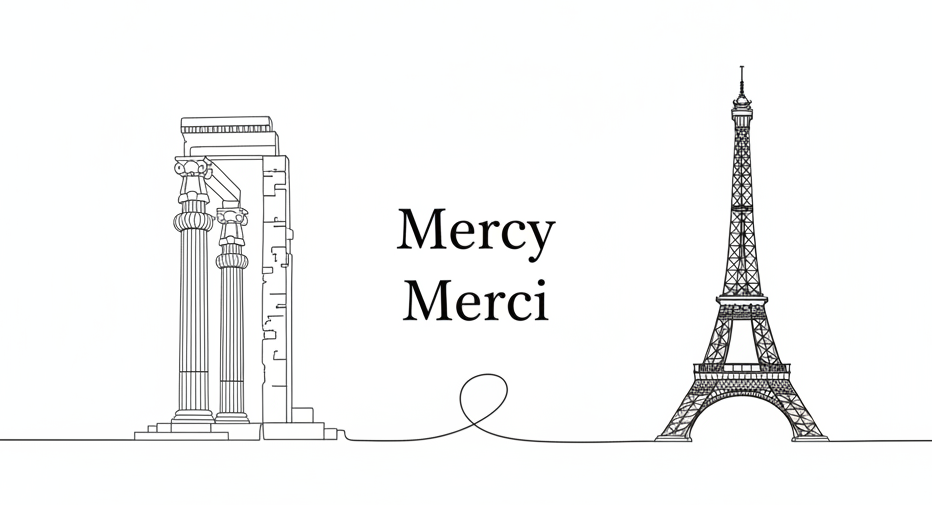
From Compassion to Gratitude: The Journey of Two Words
Introduction
Two short words from two different languages—mercy in English and merci in French—sound strikingly similar. At first glance, this resemblance may appear to be a coincidence. Yet behind these two words lies a fascinating story about the evolution of language and the shared human experiences that words often attempt to capture.
While one word expresses compassion and forgiveness, the other conveys gratitude and appreciation. Together, they point toward a deeper connection between kindness given and kindness received.
Etymology
Most linguistic research traces both words back to the Latin term mercedem (from merces), which originally referred to reward, favor, or grace.
Over time, this Latin root evolved differently across European languages. In English, the word mercy developed the meaning of compassion, forgiveness, or leniency toward someone in one’s power. In French, merci gradually came to express gratitude—an acknowledgment of kindness or favor received.
Thus, although the two words now carry different meanings, they share a common linguistic ancestry.
Some Persian-language sources have noted a possible conceptual resemblance between these words and the Persian term mehr, which in Iranian cultural tradition is associated with affection, kindness, and benevolence. However, historical linguistics does not generally establish a direct etymological link between them. The similarity, therefore, appears to be primarily conceptual rather than linguistic.
A Shared Human Meaning
Beyond their linguistic history, what makes these words particularly interesting is their close semantic relationship.
Mercy represents an act of kindness, an expression of compassion, forgiveness, or generosity. Merci, by contrast, is the response to such an act: a recognition of kindness and an expression of gratitude.
In this sense, the two words can be understood as different stages of the same human experience:
-
An act of compassion or kindness.
-
The reception of that kindness.
-
The expression of gratitude in return.
Seen from this perspective, mercy and gratitude form a natural moral sequence—one that reflects the social bonds that sustain human communities.
Conclusion
Regardless of whether we approach these words from the standpoint of etymology or meaning, mercy and merci ultimately guide us toward the same idea: the enduring relationship between kindness and gratitude.
Perhaps the lasting power of these words lies precisely in this connection. They remind us that human relationships often begin with an act of compassion and are completed with an expression of thanks.