




For more than three decades, globalization has been the foundation of economic growth, enabling businesses to expand across borders, reduce production costs, and connect billions of consumers through increasingly integrated supply chains. Today, however, that model is undergoing one of its most significant transformations.
Escalating trade disputes, geopolitical rivalries, export restrictions, and national security concerns have encouraged many governments to rethink their dependence on global supply networks. Instead of pursuing maximum efficiency, countries are increasingly focusing on resilience, strategic autonomy, and domestic industrial capacity. This shift is redefining international trade and altering the investment strategies of multinational corporations.
Businesses are responding by diversifying suppliers, relocating manufacturing facilities, and adopting "friend-shoring" and "near-shoring" strategies to reduce geopolitical risks. While these changes improve supply chain resilience, they also increase operational costs and may contribute to higher consumer prices. For many industries, globalization is no longer solely about minimizing costs—it is about managing uncertainty.
Despite these developments, globalization is unlikely to disappear. Rather than collapsing, it is evolving into a more regionalized and strategically fragmented system. Digital commerce, cross-border services, artificial intelligence, and financial technology continue to connect global markets even as physical supply chains become more localized.
For emerging economies and small and medium-sized enterprises (SMEs), this transformation presents both challenges and opportunities. Businesses capable of adapting to new trade routes, regulatory environments, and digital marketplaces will be better positioned to compete in the next phase of global commerce.
The future of globalization will likely be defined not by unlimited integration but by selective cooperation, trusted partnerships, and resilient economic ecosystems. For policymakers and business leaders alike, success will depend on balancing national interests with international collaboration in an increasingly complex and interconnected world.
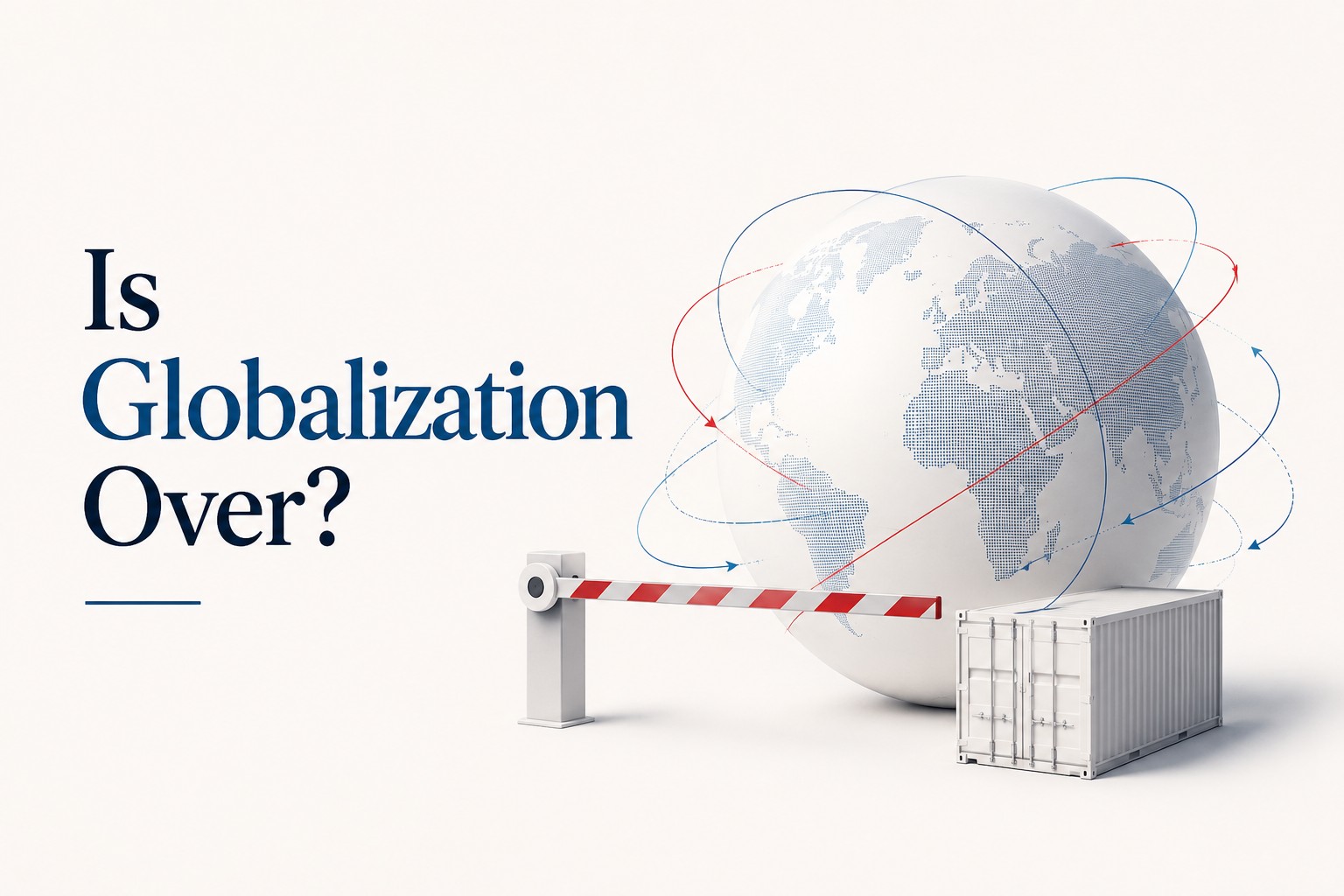
Trade barriers are rising, geopolitical tensions are reshaping supply chains, and nations are prioritizing economic security over efficiency. As the era of unrestricted global trade faces unprecedented challenges, a critical question emerges: Is globalization entering a new chapter, or approaching its end?
Font Size
1x
Reading time: 2 min