



The Science of Safe Trade: A New Framework for Sustainable Global Commerce
For decades, international trade has been measured primarily by volume, efficiency, and profitability. Governments sought to reduce barriers, businesses optimized supply chains, and investors pursued new markets with increasing speed and scale. Yet the global business environment of the twenty-first century has revealed a fundamental reality: commercial growth without resilience is increasingly unsustainable. Recent geopolitical conflicts, supply chain disruptions, cyber threats, financial instability, regulatory fragmentation, and the rapid rise of artificial intelligence have demonstrated that the future of international commerce will depend not only on expanding trade, but on securing it.
This changing landscape has given rise to what may be described as The Science of Safe Trade—a multidisciplinary framework that redefines how international business should be conducted in an era of uncertainty. Safe Trade extends beyond traditional concepts of compliance or risk management. It represents an integrated system where commercial security, institutional trust, legal certainty, technological resilience, ethical governance, and strategic intelligence function together to create sustainable economic relationships.
Historically, competitive advantage was often associated with lower production costs, larger markets, or greater manufacturing capacity. Today, however, organizations increasingly compete on a different set of assets. Reputation, transparency, cybersecurity, regulatory compliance, supply chain resilience, and stakeholder confidence have become measurable economic advantages. Businesses capable of protecting these intangible assets are often better positioned to attract investment, enter new markets, and build durable international partnerships.
One of the defining principles of Safe Trade is that trust should be treated as strategic infrastructure rather than a social value. International business operates across diverse legal systems, political environments, and cultural traditions where uncertainty is unavoidable. Under such conditions, trust reduces transaction costs, accelerates negotiations, strengthens long-term partnerships, and improves resilience during periods of economic volatility. In the emerging global economy, trust is becoming as essential to commerce as logistics, finance, or technology.
The framework also recognizes that risk itself has fundamentally evolved. Traditional business planning focused primarily on financial and operational risks. Modern international commerce must now account for cyberattacks, sanctions, geopolitical instability, data protection, ESG expectations, digital fraud, AI governance, climate-related disruptions, and reputational crises. These risks are interconnected, meaning that a failure in one area can rapidly cascade across global value chains. Safe Trade therefore emphasizes integrated risk intelligence rather than isolated risk management.
Technology occupies a central place within this new model. Artificial intelligence, blockchain, digital identity systems, predictive analytics, and smart logistics offer unprecedented opportunities to improve transparency, traceability, and operational efficiency. However, technology alone cannot guarantee secure commerce. Without ethical governance, regulatory alignment, and human oversight, technological progress may generate new vulnerabilities alongside new capabilities. The Science of Safe Trade argues that innovation must be accompanied by accountability if digital transformation is to strengthen rather than weaken international markets.
Equally important is the role of institutional quality. Sustainable commerce depends not only on private-sector performance but also on the strength of legal systems, regulatory predictability, contract enforcement, dispute resolution mechanisms, and public-private cooperation. Businesses flourish where commercial rules are transparent, institutions are reliable, and governance supports long-term investment. Safe Trade therefore recognizes that resilient economies are built through collaboration between governments, international organizations, financial institutions, and the private sector rather than through isolated action.
Small and medium-sized enterprises (SMEs) stand to benefit significantly from this approach. Traditionally, many SMEs have been disadvantaged by limited access to legal expertise, international networks, and sophisticated risk management systems. A globally recognized Safe Trade framework could provide standardized principles, practical guidance, and trusted mechanisms that reduce barriers to international expansion. By improving transparency and confidence, such a framework would enable smaller businesses to participate more effectively in global markets.
Another critical dimension of Safe Trade is cultural intelligence. International commerce is conducted between people before it is conducted between institutions. Differences in communication styles, negotiation practices, concepts of trust, and business etiquette frequently determine the success or failure of cross-border partnerships. Safe Trade therefore incorporates cross-cultural understanding as a strategic capability rather than treating it as a secondary consideration. Commercial security depends as much on understanding people as it does on understanding regulations.
Looking ahead, the future of international trade is unlikely to be defined solely by faster logistics or larger markets. Instead, it will increasingly be measured by resilience, credibility, adaptability, and responsible governance. Organizations that can combine technological innovation with institutional integrity, legal certainty, human trust, and strategic foresight will be best positioned to thrive in an increasingly interconnected and unpredictable global economy.
Ultimately, The Science of Safe Trade represents more than a new management philosophy. It offers a comprehensive framework for reimagining international commerce in an age where sustainable success depends on balancing economic opportunity with security, innovation with responsibility, and global connectivity with long-term resilience. As global markets continue to evolve, Safe Trade may become one of the defining principles shaping the next generation of international business.
WBO Executive Recommendations
The World Business Organization (WBO) encourages governments, chambers of commerce, financial institutions, and international businesses to adopt Safe Trade as a strategic framework for global commerce. Organizations should strengthen governance systems, integrate legal compliance with risk intelligence, invest in cybersecurity and digital resilience, enhance transparency across supply chains, and develop cross-cultural competencies alongside technological capabilities. WBO further recommends establishing internationally recognized Safe Trade Standards, certification systems, and capacity-building programs that enable businesses, particularly SMEs, to compete with greater confidence in international markets. In an era where trust, resilience, and responsible innovation define commercial success, Safe Trade should become a core pillar of sustainable global economic development.
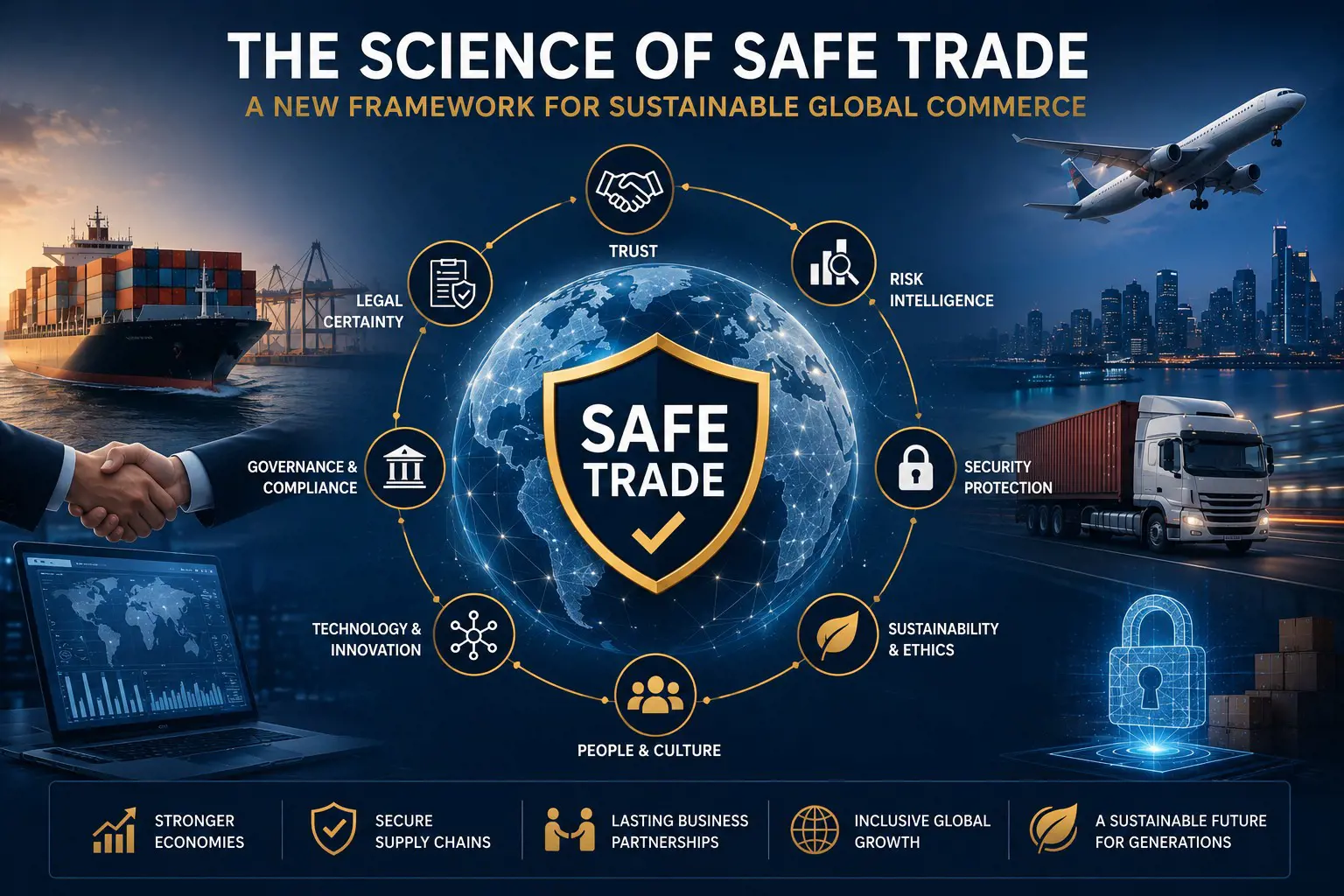
In an increasingly uncertain global economy, commercial success depends on more than competitive pricing or market access. Safe Trade is emerging as a comprehensive framework that integrates trust, governance, legal compliance, risk intelligence, and technological resilience to build secure, sustainable, and internationally trusted business relationships.
Font Size
1x
Reading time: 5 min