




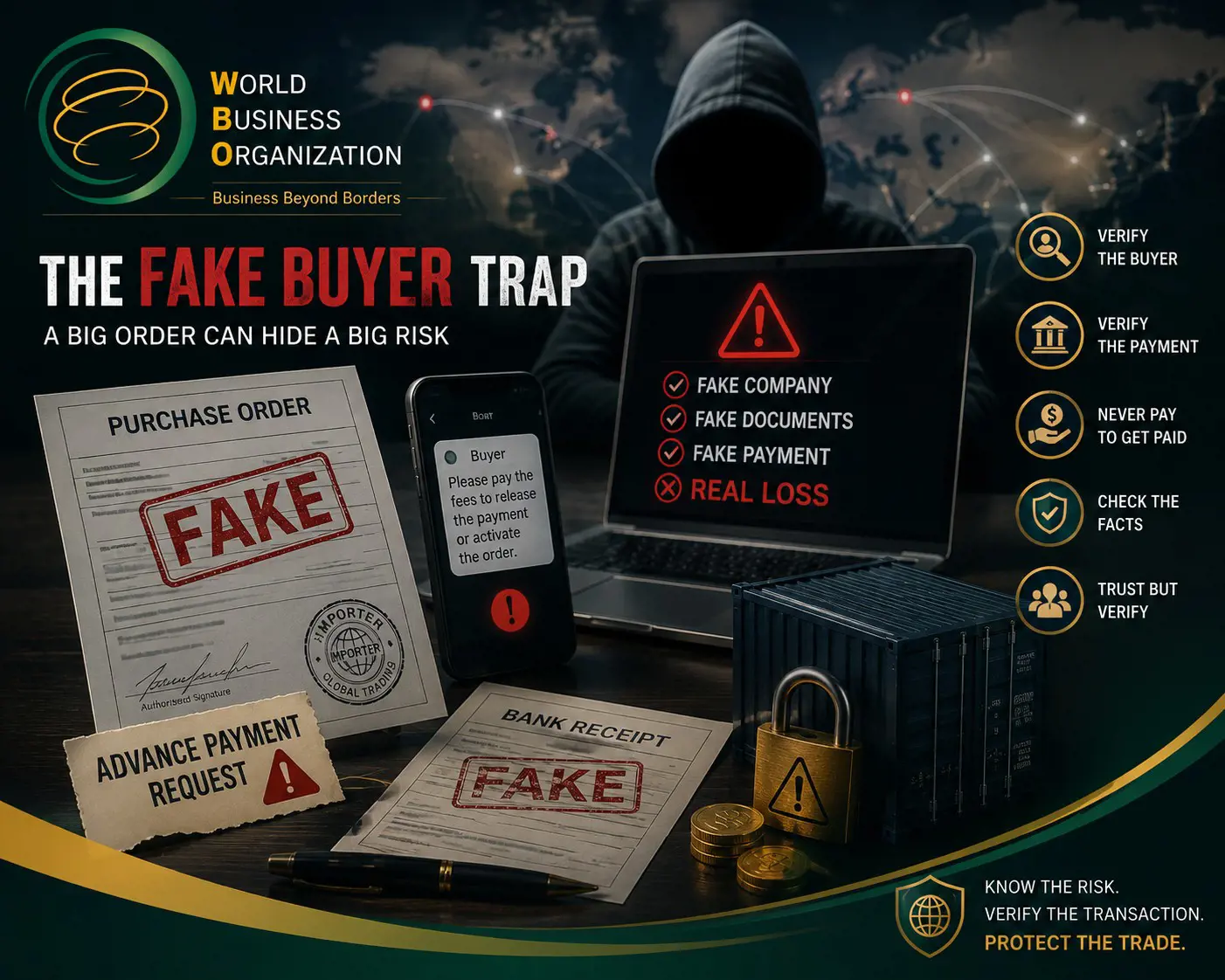
Threats Lurking: The Fake Buyer Trap
One of the most common fraud schemes in international trade involves a fraudulent buyer or fake purchase order. In this scenario, a fraudster presents themselves as a credible importer, distributor, or corporate buyer and approaches an exporter with what appears to be a significant commercial opportunity.
The fraudster may provide a professional Purchase Order (PO), company profile, contract, corporate website, business registration documents, official-looking correspondence, or even banking information to create an appearance of legitimacy. After establishing trust, the fraudster may request an upfront payment for supposed costs such as import permits, inspection, insurance, customs clearance, bank charges, registration fees, or transaction activation.
Another variation is the fake payment confirmation. The buyer sends a forged bank receipt, payment confirmation, or screenshot and pressures the seller to release goods or transfer money to another account. The seller later discovers that no funds were actually received.
The Critical Rule
Payment Proof ≠ Payment Received
A bank receipt, screenshot, copied SWIFT message, email, or payment confirmation provided by the buyer should never be treated as conclusive evidence that funds have been credited to the seller's account.
Practical Controls for Traders
-
Verify the buyer independently. Check the company's legal existence, ownership, registered address, management, trading history, and reputation.
-
Verify the payment through your own bank. Do not rely on documents supplied by the buyer as proof of settlement.
-
Never “pay to get paid.” Be highly cautious when a buyer asks you to pay a fee before a promised payment can be released.
-
Verify communication channels. Do not rely solely on email addresses, websites, or contact information supplied by the prospective buyer.
-
Assess the commercial logic. An unknown buyer offering an unusually large order with unrealistic terms or excessive urgency should trigger enhanced due diligence.
-
Confirm the contractual entity. Ensure that the company negotiating the transaction, the contracting party, and the paying entity are properly connected and documented.
WBO’s Practical Education Approach
The World Business Organization (WBO) considers practical trade-risk education an important element of responsible international business development. Through its educational and knowledge-sharing activities, WBO aims to help traders recognize fraudulent buyer profiles, evaluate counterparties, verify payment claims, identify red flags, and establish effective transaction-control procedures.
The WBO approach is based on prevention rather than reaction: traders should learn how to test the credibility of a transaction before committing goods, capital, or confidential commercial information. Case-based training, transaction scenarios, due-diligence checklists, and practical verification procedures can help businesses turn risk awareness into daily operating controls.
Remember
A large purchase order does not necessarily mean a good business opportunity.
Verify the buyer. Verify the transaction. Verify the money.
In international trade, the size of the opportunity should never determine the level of due diligence; the level of risk should.
WBO Times | Threats Lurking
WBO Trade Risk & Compliance Desk
Practical Knowledge for Safer International Trade