




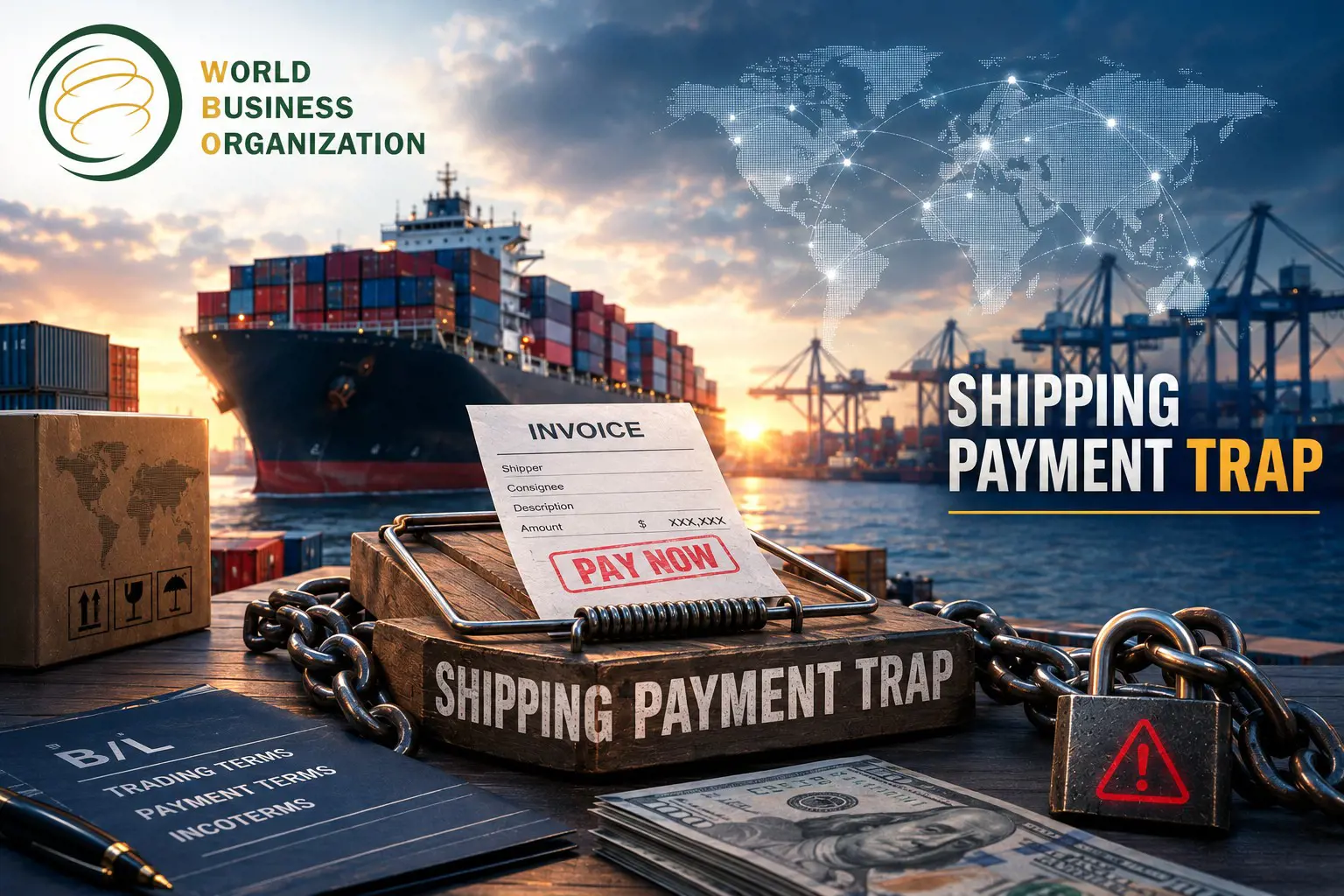
Threats Lurking: The Shipping Payment Trap
International transportation is one of the most vulnerable stages of a cross-border transaction because multiple parties may become involved: exporters, importers, freight forwarders, shipping lines, customs brokers, warehouses, insurers, and logistics agents. This complexity creates opportunities for fraudsters to manipulate payment instructions at precisely the moment when a trader is under pressure to move the shipment.
One increasingly common scheme involves the fraudulent change of shipping or freight-payment instructions. A trader may receive an email apparently from a freight forwarder, shipping company, logistics provider, or commercial partner informing them that the company's bank account has changed.
The message may look completely legitimate:
“Due to an internal banking change, please remit the freight payment to our new account.”
The fraudster may have obtained genuine information about the transaction, including the contract number, container number, vessel name, shipment date, invoice amount, and names of employees involved. This makes the fraudulent request particularly convincing.
The trader transfers the freight or logistics payment to the new account. Only later does the legitimate service provider report that the payment was never received.
Why This Fraud Is Dangerous
This is often a form of Business Email Compromise (BEC) or payment-instruction fraud. The criminal does not necessarily need to create an entirely fake transaction. Instead, they manipulate a legitimate transaction by inserting themselves into the communication chain and changing where the money goes.
Red Flags Traders Should Watch
- Unexpected changes to bank-account details
- Requests for urgent payment
- New beneficiary accounts introduced shortly before shipment
- Similar email addresses, but not identical, to the legitimate domain
- Requests to pay a third party without a clear contractual basis
- Bank accounts located in an unexpected jurisdiction
- Pressure to complete payment before independent verification
Practical Controls:
- Never change payment instructions based solely on email.
Any change to beneficiary information should trigger independent verification. - Call the company using a previously verified telephone number.
Do not use the telephone number contained in the suspicious email. - Apply a dual-approval procedure.
High-value changes to payment instructions should require confirmation by at least two authorized individuals. - Compare the beneficiary with the contract.
The legal entity receiving payment should correspond to the contractual and invoicing structure. - Treat urgency as a risk signal.
A request that combines a new bank account with extreme urgency deserves enhanced scrutiny.
WBO’s Practical Education Approach
The World Business Organization (WBO) considers transaction-security awareness an essential component of modern international trade. Through its educational and knowledge-sharing activities, WBO aims to equip traders with practical methods for identifying payment manipulation, BEC, fraudulent logistics communications, and other risks within the international supply chain.
The WBO practical education approach focuses on turning awareness into operational discipline. Traders should be trained to recognize red flags, verify counterparties through independent channels, establish payment-verification protocols, and introduce internal controls before money is transferred.
The Golden Rule
"Never change payment instructions based solely on an email."
In international trade, the question is not simply “Who sent this message?”
The more important question is:
“Have we independently verified where our money is actually going?”
WBO Times | Threats Lurking
WBO Trade Risk & Compliance Desk
Practical Knowledge for Safer International Trade