




Xi’s Washington Visit and Global Market Psychology
Chinese President Xi Jinping’s state visit to Washington and his meetings with U.S. President Donald Trump have become an important economic event for global markets. The significance of the visit extends beyond the immediate trade agreements: investors are also attempting to interpret what the meetings mean for future tariffs, technology restrictions, supply chains and the broader risk environment.
The two countries agreed to extend their trade truce, reduce tariffs on around $30 billion of goods, establish a trade council and continue negotiations. They also agreed to create a dialogue on artificial intelligence and establish a communication channel for AI-related incidents.
For markets, however, the most important variable may be expectations.
Ahead of the summit, investors had already begun positioning around the possibility of greater stability in U.S.-China relations. China's yuan reached a more than three-and-a-half-year high against the dollar before the meeting, while analysts linked the currency's strength partly to expectations surrounding the summit and a more supportive approach from the People's Bank of China.
This illustrates a fundamental principle of market psychology: financial markets often respond to the anticipated future before the economic effects of political decisions become measurable.
The psychology is particularly important because the agreement does not resolve the structural disagreements between Washington and Beijing. Tariffs, rare-earth supplies, technology restrictions, artificial intelligence and strategic competition remain significant issues. Reuters described the two-month extension of the trade truce as providing additional time for negotiations rather than delivering a comprehensive settlement.
This creates a complex psychological environment. A temporary reduction in trade uncertainty can support risk appetite, while the absence of a permanent agreement can prevent investors from treating the improvement as a definitive change in the global economic outlook.
Commodity markets are also closely connected to the relationship. Agriculture, energy and rare earths have become important bargaining areas in U.S.-China trade relations, meaning that diplomatic developments can influence expectations for commodity demand, supply and prices.
The psychological effect extends to equities as well. Technology investors are particularly sensitive because AI has become both an economic opportunity and a strategic area of competition between the two countries.
The broader lesson for global markets is clear: geopolitical diplomacy is increasingly becoming part of market pricing.
Investors are not simply asking whether the United States and China have reached an agreement. They are asking whether the agreement changes the probability of future escalation. That distinction matters.
A reduction in perceived geopolitical risk can influence currencies, equities, commodities and investment decisions even before trade flows materially change.
Xi’s Washington visit therefore demonstrates an increasingly important feature of the global economy: markets trade not only on economic fundamentals, but also on expectations, uncertainty and the collective interpretation of political signals.
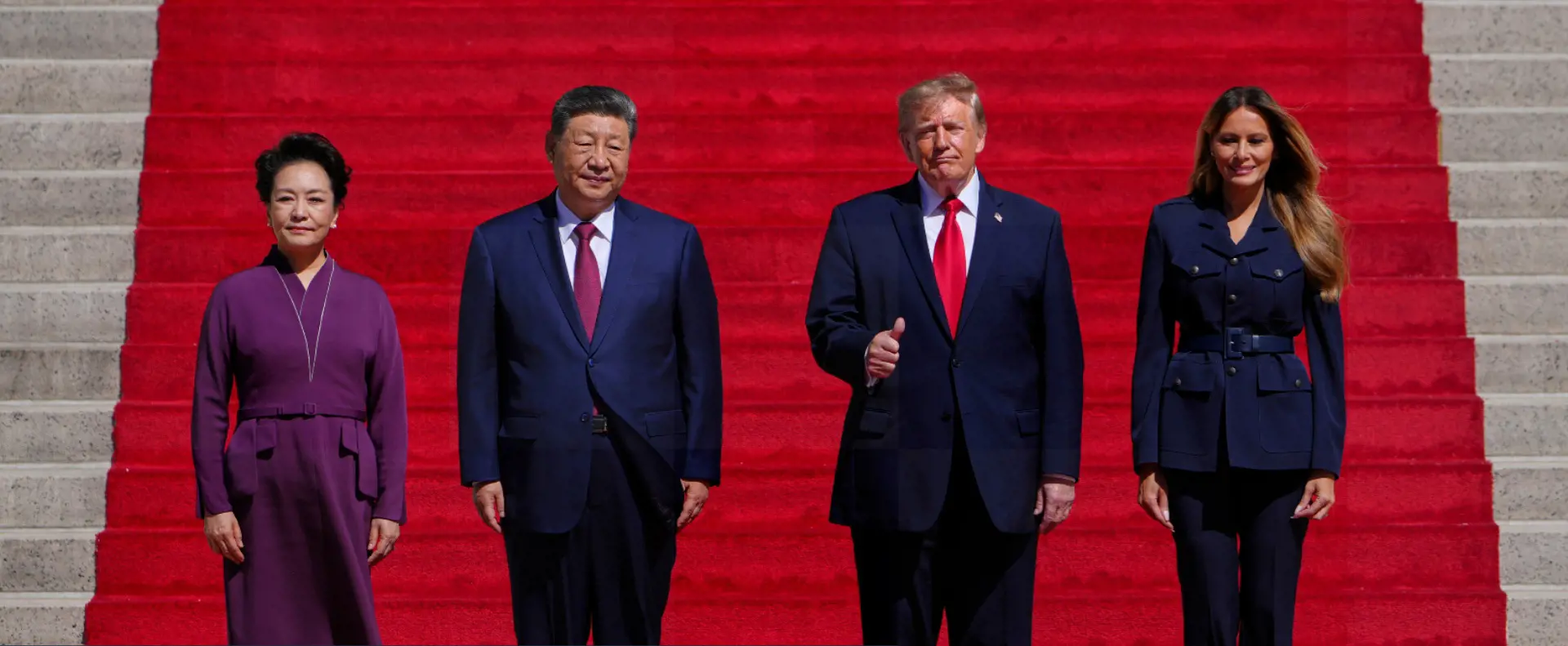
Xi Jinping’s 2026 Washington visit has reshaped market expectations around trade, technology and geopolitical risk, influencing currencies, equities, commodities and investor sentiment.
Font Size
1x
Reading time: 3 min