




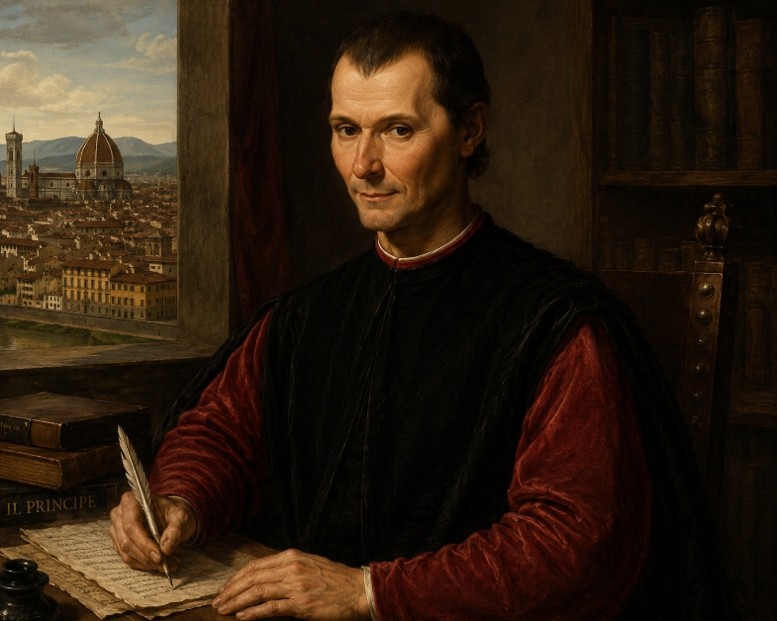
Historical Intelligence Interview with Machiavelli
Interviewer: Can morality and power coexist?
Machiavelli: If you ask me, I will say that morality and power may travel the same road, but they are not the same thing. The greatest mistake of rulers is to imagine that the world is governed by how it ought to be rather than by how it truly is. A prince who concerns himself only with virtue will soon be ruined among men who concern themselves with power. Yet a ruler who seeks only power will eventually lose loyalty and confidence, upon which all enduring authority depends. Therefore, a wise ruler neither rejects morality nor becomes its prisoner. He strives to be virtuous whenever circumstances permit, but when the preservation of the state is at stake, he must place the survival of the political order above all other considerations. In politics, men judge more with their eyes than with their hands. Few can know the truth, but all can see appearances. Thus, a ruler must possess virtue when possible and always appear virtuous.
Interviewer: What qualities define successful leaders?
Machiavelli: Most people believe successful leaders are those who are merely more intelligent or more courageous than others. History teaches a different lesson. The truly successful leader understands the spirit of the times and adapts his conduct accordingly. Many powerful rulers did not fall because they lacked strength; they fell because they clung to methods that once brought success but no longer suited changing circumstances. Three qualities are indispensable. First, an understanding of human nature. Men are moved less by reason than by fear, ambition, desire, hope, and self-interest. Second, decisiveness in uncertainty. No ruler ever possesses complete knowledge, yet he must still act. Hesitation often destroys more kingdoms than error. Third, mastery over perception. Reality matters, but in political life, the public's perception of reality often matters even more. A leader who cannot shape the narrative surrounding his actions may achieve success and yet be remembered as a failure.
Interviewer: Are large corporations the new states of the modern world?
Machiavelli: If I lived in your century, I would study this phenomenon with great interest. In my time, states commanded armies, collected revenues, and shaped public opinion. Today, many great corporations exercise influence over information, communication, commerce, and even political behavior on a scale once reserved for sovereign powers. Yet an important distinction remains. A state possesses legitimate force. A corporation does not. The state may compel obedience; the corporation must persuade, incentivize, or influence. Nevertheless, the relationship is becoming increasingly complex, for governments themselves have grown dependent upon the infrastructures and systems controlled by powerful private institutions. If I once wrote of The Prince, perhaps today I would write of The Platform. For power now resides not only in palaces and parliaments, but also in networks, algorithms, and systems that govern the flow of information across entire societies.
Interviewer: How is power defined in the age of media and social networks?
Machiavelli: In my age, power was measured by the control of territory. Later, it was measured by the control of capital. In your age, power is increasingly measured by the control of attention. Any individual, institution, corporation, or government capable of directing the attention of millions possesses a new and formidable form of power. The principal battlefield of your century is no longer the fortress, the treasury, or even the marketplace. It is the human mind. Those who can shape fear, hope, anger, desire, and belief can influence behavior itself. And those who influence behavior govern outcomes. In former times, rulers dispatched armies to conquer cities. Today, a narrative, a viral message, or a carefully crafted story may achieve what thousands of soldiers cannot. Therefore, if you ask me what constitutes the greatest source of power in the twenty-first century, my answer would be simple:
The ability to shape perception.
For men do not act according to reality alone. They act according to what they believe reality to be. And he who commands that belief commands a portion of the world itself.
Interviewer: Is there a question you wish people would ask you as Machiavelli, but no one ever has?
Niccolò Machiavelli: Yes. If, after five centuries, I was granted the opportunity to raise one new question, it might be this:
- “For what purpose should power be preserved?”
Remarkably, so many who have read my works have asked how power may be acquired, how it may be maintained, how rivals may be defeated, and how populations may be governed. Yet very few have asked what the ultimate purpose of power ought to be once it has been obtained. For power is not an end. Weak rulers seek power merely for their own survival. Great rulers seek power to build something that will outlive them. Alexander conquered vast territories. Yet the more important question is not how he achieved victory, but what remained after he was gone. Any rulers throughout history who succeeded in preserving their authority, yet failed to build civilization. They retained their thrones but lost the future. If I were living at your age, I might raise another question as well:
- “In a world where algorithms shape human thought, does the prince still exist, or has power passed into the hands of machines?”
In my time, the prince was the man who commanded armies. In later centuries, the prince became the man who controlled capital. But today, the true prince may be the one who governs the flow of information; the one who determines what people see, what they believe, and what they fear. And perhaps the most important question that no one has ever asked me is this:
- “If I were writing The Prince today, who would its audience be?”
Would it be presidents and prime ministers?
Would it be the leaders of multinational corporations?
Would it be the owners of digital platforms?
Or would it be the architects of artificial intelligence?
I suspect the last answer is the most unsettling of all.
For the first time in history, it has become possible not merely to influence human behavior, but to shape the very process by which human beings make decisions. And on that day, the central question will no longer be how power is preserved. It will be what it means to remain human.