




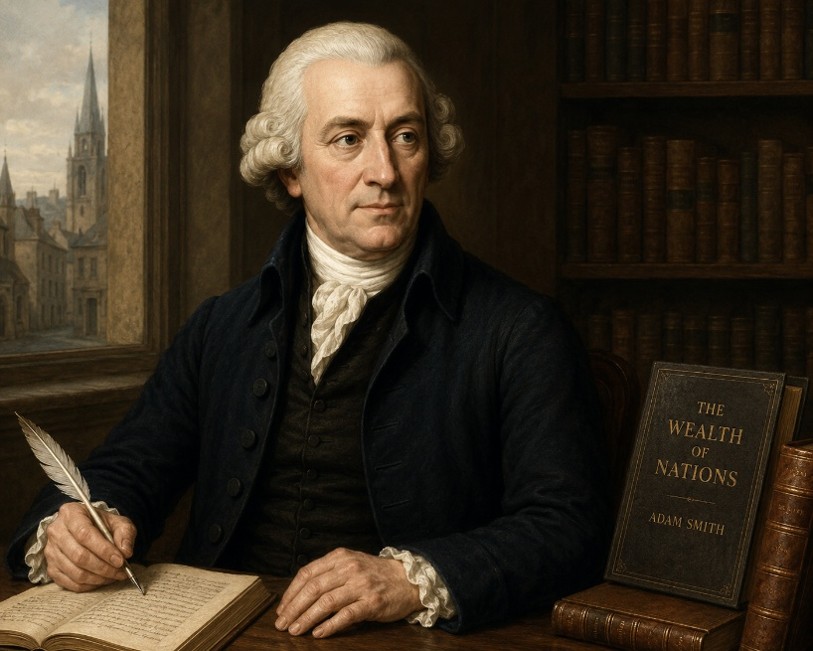
Historical Intelligence Interview with Adam Smith:
Interviewer: Mr. Smith, does your concept of the “invisible hand” still function in today’s data-driven and platform-based economies?Adam Smith: In my original framework, I assumed that information was dispersed among market participants and that competition would translate this dispersion into prices. In today’s world, however, the issue is no longer a scarcity of information, but its extreme concentration within certain institutions. In platform economies, some actors do not merely participate in markets; they actively help define the market itself. The invisible hand still exists, but it is no longer sufficient on its own. It operates alongside highly visible structures of data and concentrated power. Its effectiveness depends on institutions that preserve competition and ensure informational transparency.
Interviewer: So would you say modern capitalism has shifted from value creation toward preference engineering?
Adam Smith: In my classical analysis, economic value emerged from production, specialization, and productivity. Today, however, a significant portion of economic activity is not merely responding to demand but actively shaping it. This is not purely a technological transformation; it is also an ethical one. If markets no longer simply reflect existing needs but actively participate in forming those needs, then the boundary between free choice and guided choice becomes increasingly blurred. The key question is whether society possesses the institutional tools to distinguish between the two.
Interviewer: In such a system, what is the role of the state? Should government intervention increase?
Adam Smith: In classical political economy, the state functioned as an arbiter rather than a player. Today, however, the boundary between markets and the state—and even between corporations and public institutions—has become highly fluid. Some firms now operate at a scale exceeding that of many governments, while some governments have become direct participants in digital economies. The central issue is not the size of the state, but its function. The state must act as a guardian of competition rather than a controller of markets. Its role is to prevent economies of scale from becoming permanent structures of domination, without replacing the market itself.
Interviewer: How do you view the future of global trade? Is globalization coming to an end?
Adam Smith: The principle of comparative advantage remains valid. However, trade is no longer limited to goods exchange; it now encompasses technology, data, and security considerations. As a result, trade has shifted from a purely economic mechanism to a strategic instrument. We are not witnessing the end of globalization, but rather its reconfiguration. Global supply chains are moving toward resilience and diversification, even at the cost of short-term efficiency. The tension between efficiency and security has become a defining feature of the modern economic order.
Interviewer: If you could revise one core aspect of your theory, what would it be?
Adam Smith: I would place far greater emphasis on the fact that competition is not a natural and stable condition, but an institutional one that requires continuous maintenance. In my time, competition was often treated as a default state. Modern economic experience demonstrates that without deliberate institutional design, competition tends naturally toward concentration, especially in networked, data-intensive economies. Therefore, the key revision would be this: the invisible hand is not a universal law, but an institutional phenomenon dependent on the architecture that sustains it.
Interviewer: Mr. Smith, do your criticisms of thinkers such as Marx still hold today?
Adam Smith: If I speak precisely, many of my criticisms of structuralist interpretations of economics still hold, though not in an absolute or unconditional sense. From my perspective, a key issue in certain theories—particularly those developed in the Marxian tradition—is an excessive emphasis on “conflict as the primary engine of economic history,” while underestimating the role of “decentralized coordination emerging from voluntary exchange.” I continue to believe that markets, even without a unified moral intention, can generate order—something that is less emphasized in purely class-conflict-based analyses. However, historical experience also shows that markets do not automatically converge toward a fair or stable equilibrium. Therefore, my critique is no longer a claim that markets are fundamentally flawed, but rather a critique of the assumption that markets are sufficient on their own without corrective institutions.
Interviewer: Do you agree with any elements of Marx’s analysis?
Adam Smith: Here, the discussion becomes more nuanced. If we take a non-ideological and precise view, some of his observations about modern capitalism are difficult to deny. For example:
- The tendency of capital to concentrate at large scales
- Persistent pressure to increase productivity through technological advancement
- Periodic instability within economic cycles
- And potential structural inequalities in the distribution of economic power
I agree with these descriptions to some extent, but I differ in their interpretation. He views them as “internal contradictions of the system,” whereas I interpret them as “institutionally shaped and potentially correctable outcomes.” The difference is fundamental: he leans toward historical necessity, whereas I lean toward institutional design.
Interviewer: What is your critique of other traditions in political economy?
Adam Smith: Beyond Marx, my position remains consistent toward other schools of thought. I continue to be critical of any theory that commits one of two errors: Either it moralizes the economy while ignoring the real mechanisms of incentives, or it treats the economy as purely mechanical while excluding the roles of morality, trust, and institutions. In my view, both approaches produce an incomplete understanding of how markets function.
Interviewer: Has your perspective changed over time?
Adam Smith: Yes, but not in foundational principles, rather in emphasis. In my own time, my primary concern was excessive state intervention and constraints on competition. If I were to extend my reasoning to the modern world, however, different concerns would become more prominent: How economic power can undermine competition without direct coercion; how data and networks may weaken the price mechanism as a system of information discovery; and how hidden forms of concentration can reproduce monopoly-like effects without formal monopoly structures. These were not issues that existed at such intensity in my era.
Adam Smith: If I were to summarize my position in a single statement, I remain committed to the idea of spontaneous market order, but I no longer see it as independent of institutions, power structures, or mechanisms of concentration. Consequently, my disagreement with many thinkers is not about accepting or rejecting markets, but about this distinction: I do not see markets as a fixed natural condition; I see them as an institutional structure that is continuously designed and redesigned.
Interviewer: What is your view on artificial intelligence, the digital economy, and the possibility of human labor being eliminated?
Adam Smith: If I respond from the perspective of the intellectual framework associated with Adam Smith, artificial intelligence should be understood as an extension of what I once called the “division of labor.” However, there is a fundamental difference: this time, not only physical skills but also many cognitive capacities are becoming substitutable. From my perspective, any technology that increases productivity may initially displace or even eliminate certain forms of labor. Yet at the aggregate level, it typically leads to the creation of new forms of employment and economic activity. The central issue is never simply the “elimination of work,” but rather the “redistribution of labor within a new structure of production.” However, this transition is not always smooth or equitable.
Interviewer: Is there a fundamental difference this time compared to previous industrial revolutions?
Adam Smith: Yes, there is an important difference. In earlier industrial revolutions, machines primarily replaced human physical capacity. But in the digital economy, we are dealing with a form of capital that can replace aspects of decision-making, analysis, and even choice itself. This has a significant implication: whereas in the past humans moved from manual labor toward more specialized forms of work, today even specialized tasks may be transferred to automated systems. In such a context, the issue is no longer merely “productivity,” but the very “nature of the human role in the production process.”
Interviewer: Do you see this trend as a threat to labor markets and wages?
Adam Smith: In my analysis, wages are determined by the supply of labor, demand for labor, and productivity. Artificial intelligence can significantly increase productivity, but its effect on wages depends on whether the ownership of this productivity remains concentrated or not. If the gains from this technology are concentrated in the hands of a small group of investors and technological institutions, then the likelihood of rising inequality is high. However, if these gains are distributed through competition, redistributive institutions, and broader access to digital means of production, it can lead to increased overall welfare.
Interviewer: In such a structure, what is the role of the state?
Adam Smith: The role of the state here extends beyond its traditional function. The state is no longer merely a regulator of markets; it must also act as a guardian of competitive conditions in digital environments. This includes preventing excessive data concentration, ensuring equal access to digital infrastructure, and regulating platform power. However, I still maintain the principle that the state should not replace market mechanisms. Rather, it should create the conditions under which markets can function competitively and dynamically.
Interviewer: Finally, do you see artificial intelligence as the beginning of the “end of human labor”?
Adam Smith: Not in an absolute sense. What is more likely is not the end of human labor, but a transformation in its nature. Humans will move away from repetitive and predictable tasks toward roles involving judgment, design, oversight, and the definition of objectives. However, one point must be taken seriously: if institutional structures evolve in such a way that humans are excluded from ownership of the new means of production, this transformation may lead not to greater freedom, but to a concentration of economic power. Therefore, the central issue of artificial intelligence is not the “replacement of humans,” but the “distribution of power within the new system of production.”