




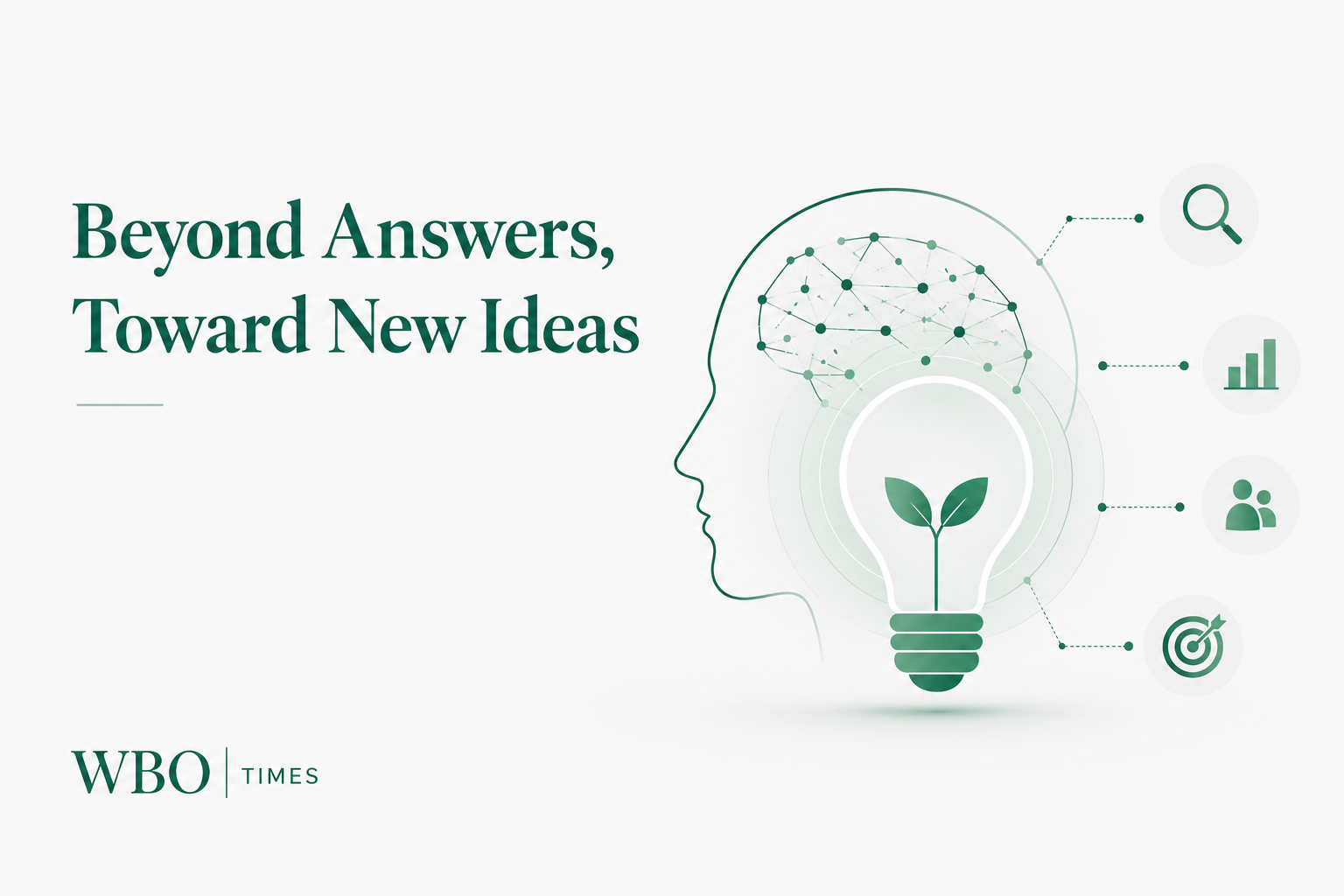
Will AI Only Answer Our Questions, or Will It Start Creating New Business Ideas?
Until recently, most business leaders have used artificial intelligence to write content, analyze data, automate workflows, or generate reports. However, a newly published research project points to a very different future, one in which AI is no longer just an execution tool but an intellectual partner capable of generating entirely new ideas. Researchers have introduced a system called **auto-psych**, designed to automate much of the scientific research cycle in psychology. Rather than simply analyzing existing data, the system reviews thousands of scientific papers, identifies gaps in current knowledge, formulates new hypotheses, designs experiments, analyzes the results, and then refines its own theories based on the evidence. Although the research focuses on psychology, its implications extend far beyond academia. For businesses, it suggests a shift in the role of AI, from answering questions to discovering questions that no one has thought to ask. Imagine applying the same approach inside an organization.
Instead of asking AI, *"How can we increase sales?"* The system could independently examine customer behavior, market trends, and operational data before proposing insights such as:
- This customer segment has an unmet psychological need.
- Customers abandon purchases because of a hidden trust barrier.
- Employees in this department show motivational patterns that predict future turnover.
These are not direct answers to existing questions. They are entirely new hypotheses that managers may never have considered. This represents a fundamental change in how organizations innovate.
Today, executives typically define the problem and ask AI for solutions. Tomorrow, AI may help identify the problems worth solving in the first place. From a psychological perspective, this is equally significant. Consumer decisions, employee motivation, leadership effectiveness, trust, organizational culture, and customer loyalty are all rooted in human behavior. If AI can generate scientifically grounded hypotheses about these behaviors, organizations could move from intuition-based management toward evidence-driven innovation.
The researchers are careful to note that AI is **not replacing human scientists or business leaders**. Human judgment remains essential for evaluating ideas, interpreting findings, addressing ethical considerations, and making strategic decisions.
Instead, AI becomes a creative research partner that expands the range of possibilities humans can explore. The broader implication is clear: the competitive advantage of the AI era may no longer come from using AI simply to work faster. Instead, it will come from using AI to uncover opportunities, patterns, and business ideas that have remained invisible until now. The organizations that learn to collaborate with AI in this way may gain something more valuable than efficiency; they may gain the ability to discover tomorrow's opportunities before anyone else even realizes they exist.
Dr. Sara Mei
Psycho-Trade Think Tank Chairman