




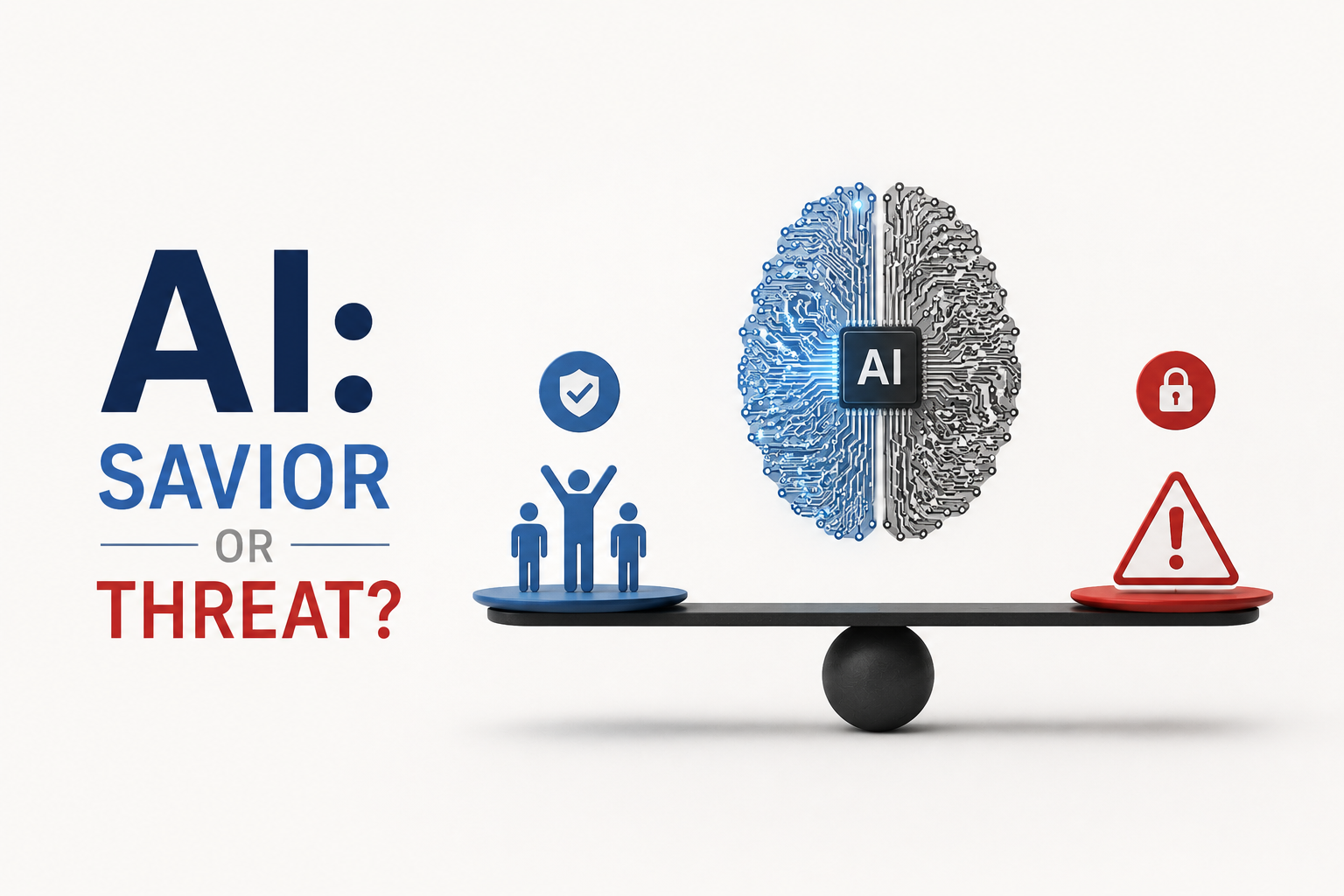
AI: Savior or Threat?
Artificial intelligence has moved beyond the realm of emerging technology to become one of the defining economic forces of the 21st century. From healthcare and finance to manufacturing, logistics, education, and scientific research, AI is changing how organizations operate, compete, and create value. Governments and corporations are investing hundreds of billions of dollars in AI infrastructure, making it one of the fastest-growing sectors in the global economy.
Supporters argue that AI represents the next industrial revolution. Intelligent automation can improve productivity, reduce operational costs, accelerate scientific discovery, and enable businesses to make faster and more informed decisions. For small and medium-sized enterprises, AI has the potential to democratize access to advanced technologies that were once available only to large corporations.
However, the rapid expansion of AI has also generated growing concerns. Automation is expected to reshape labor markets, eliminating some jobs while creating entirely new professions that require different skills. The pace of technological change is raising important questions about workforce adaptation, education systems, and the future of employment. Businesses that fail to invest in digital skills may struggle to remain competitive in an AI-driven economy.
Beyond employment, AI introduces complex challenges related to cybersecurity, data privacy, misinformation, intellectual property, and ethical governance. As AI systems become more autonomous and influential, governments and international organizations face increasing pressure to establish regulations that encourage innovation while protecting public interests.
The future of AI will not be determined by technology alone. It will depend on how responsibly governments, businesses, educators, and society manage its development and deployment. Organizations that combine innovation with transparency, ethical standards, and human-centered leadership will be best positioned to realize AI's enormous potential.
Artificial intelligence is neither inherently a savior nor a threat. It is a transformative tool whose ultimate impact will be shaped by the choices humanity makes today. The challenge is no longer whether AI will change the global economy—but whether the global economy is prepared for the age of artificial intelligence.