


Global Business Education Faces a Turning Point as Experts Call for New International Standards
The world of commerce is undergoing one of the most profound transformations in modern history. Artificial intelligence is reshaping decision-making, geopolitical tensions are redefining supply chains, sustainability has become a strategic necessity, and digital trade is rapidly replacing traditional business models. Yet despite these fundamental shifts, much of today's business education continues to rely on concepts developed for a vastly different economic landscape. Industry observers increasingly argue that the greatest risk facing businesses is not a lack of opportunity—but a growing mismatch between today's commercial realities and the knowledge many entrepreneurs possess.
This challenge is particularly critical for small and medium-sized enterprises (SMEs), which account for the overwhelming majority of businesses worldwide but often lack access to high-level strategic education and internationally aligned commercial standards. Without practical training in areas such as geopolitical risk analysis, behavioral economics, AI-driven decision-making, international compliance, sustainable trade, cross-border negotiation, and modern supply-chain management, many SMEs struggle to compete in increasingly complex global markets.
Responding to this emerging gap, the World Business Organization (WBO) has launched an integrated international business education framework designed specifically for the next generation of global commerce. Rather than focusing solely on conventional management theories, the WBO's educational model combines commercial strategy with real-world market intelligence, international trade practices, investment readiness, business psychology, risk management, and globally applicable business standards. Through structured certification programs, executive workshops, international business missions, and cross-border networking platforms, participants gain practical competencies that extend far beyond traditional classroom learning.
According to WBO officials, the objective is not simply to educate business leaders, but to establish a common international language of commercial excellence that enables companies from different regions to collaborate more effectively, reduce operational risks, and accelerate sustainable growth. As global markets become increasingly interconnected and technology continues to redefine competitive advantage, organizations that invest in modern business education today are expected to become tomorrow's most resilient and internationally competitive enterprises.
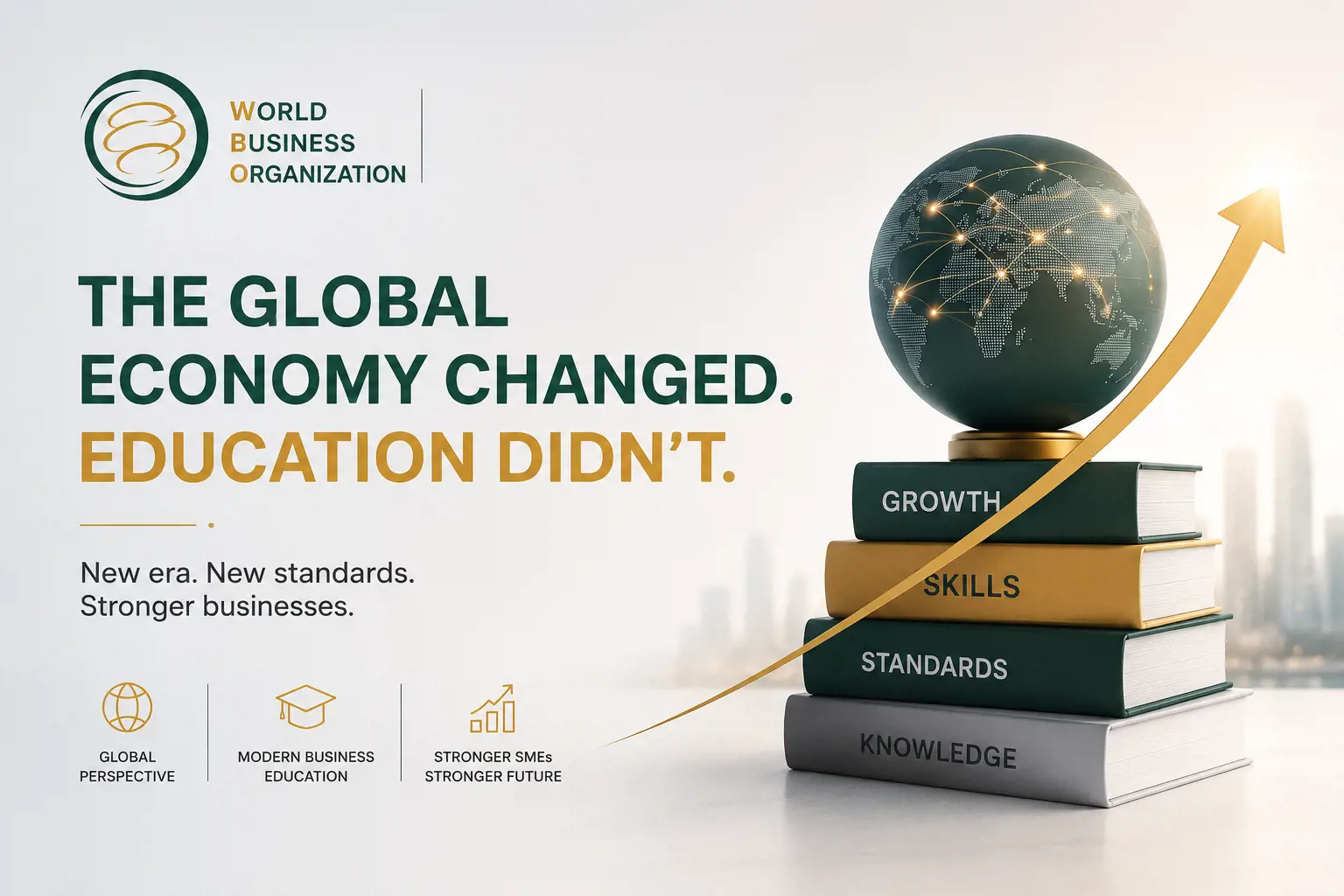
As artificial intelligence, geopolitical uncertainty, and rapid market transformation redefine global commerce, experts warn that traditional business education is no longer sufficient. The World Business Organization (WBO) is leading a new international initiative aimed at equipping SMEs with modern commercial competencies and globally recognized business standards.
Font Size
1x
Reading time: 2 min