




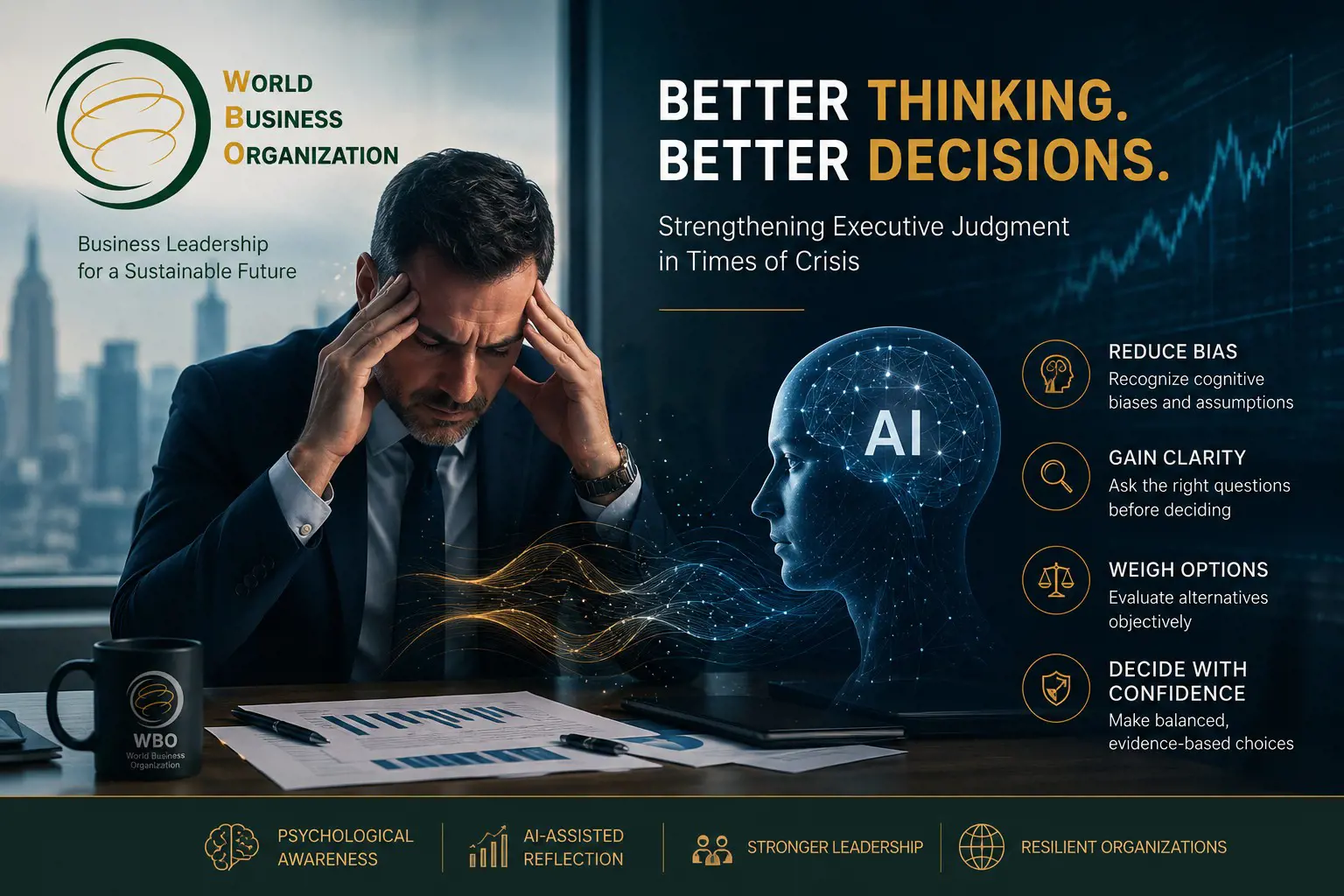
How Stress Changes Executive Decisions During Financial Crisis: A Psychological and AI-Assisted Perspective
Financial crises test more than an organization's financial stability; they test the psychological resilience and decision-making capacity of its leaders. While executives are expected to remain rational under pressure, research in psychology and neuroscience suggests that stress fundamentally alters the way decisions are made. Understanding these psychological mechanisms is essential for improving leadership performance during periods of uncertainty.
Artificial intelligence (AI) may also play an important role, not by replacing executive judgment, but by improving the quality of thinking that precedes critical decisions. Acute financial stress activates the brain's survival system. Elevated levels of stress hormones increase emotional processing while reducing the effectiveness of the prefrontal cortex, the region responsible for strategic thinking, planning, and self-control. As a result, executives may unknowingly rely more on emotional reactions than analytical reasoning. Although they often believe they are making objective decisions, their judgment is increasingly influenced by fear, uncertainty, and cognitive bias.
One significant consequence of prolonged stress is the decline of working memory. Executives struggle to evaluate multiple scenarios simultaneously, compare alternatives objectively, and anticipate long-term consequences. Decision-making becomes narrower and more reactive, reducing the ability to generate innovative solutions during the very moments when creativity is most needed.
Another important psychological phenomenon is **threat rigidity**. Faced with uncertainty, leaders tend to centralize authority, reduce experimentation, rely on familiar strategies, and avoid calculated risks.
While these behaviors may create temporary stability, they often weaken an organization's adaptability during extended crises. At the same time, repeated high-stakes decisions produce **decision fatigue**, gradually exhausting cognitive resources. Leaders become more likely to delay difficult decisions, choose the easiest available option, or avoid making decisions altogether.
Stress also spreads throughout organizations. Leaders' emotional states influence the psychological climate of their teams, a phenomenon known as emotional contagion. Anxiety expressed by executives can reduce confidence, increase uncertainty, and impair collective decision-making across the organization. Consequently, leadership psychology becomes a critical determinant of organizational Performance during financial crises.
Artificial intelligence offers a valuable opportunity to improve executive decision-making by acting as a reflective cognitive assistant rather than an autonomous decision-maker. Instead of generating final answers, AI can encourage structured reflection by asking questions such as: *Is this decision driven by evidence or fear? What assumptions are influencing your judgment? Have alternative scenarios been considered? * These prompts help leaders recognize cognitive biases, slow impulsive thinking, and make more balanced decisions.
Financial crises do not simply create poor decisions; they alter the psychological conditions under which decisions are made. Therefore, strengthening executive performance requires more than better financial data. It requires protecting the quality of human thinking itself. Integrating psychological science with AI-assisted reflection offers an innovative framework for supporting leadership, improving decision quality, and building more resilient organizations in times of uncertainty.
Dr. Sara Mei
Psycho-Trade Think Tank Chairman