




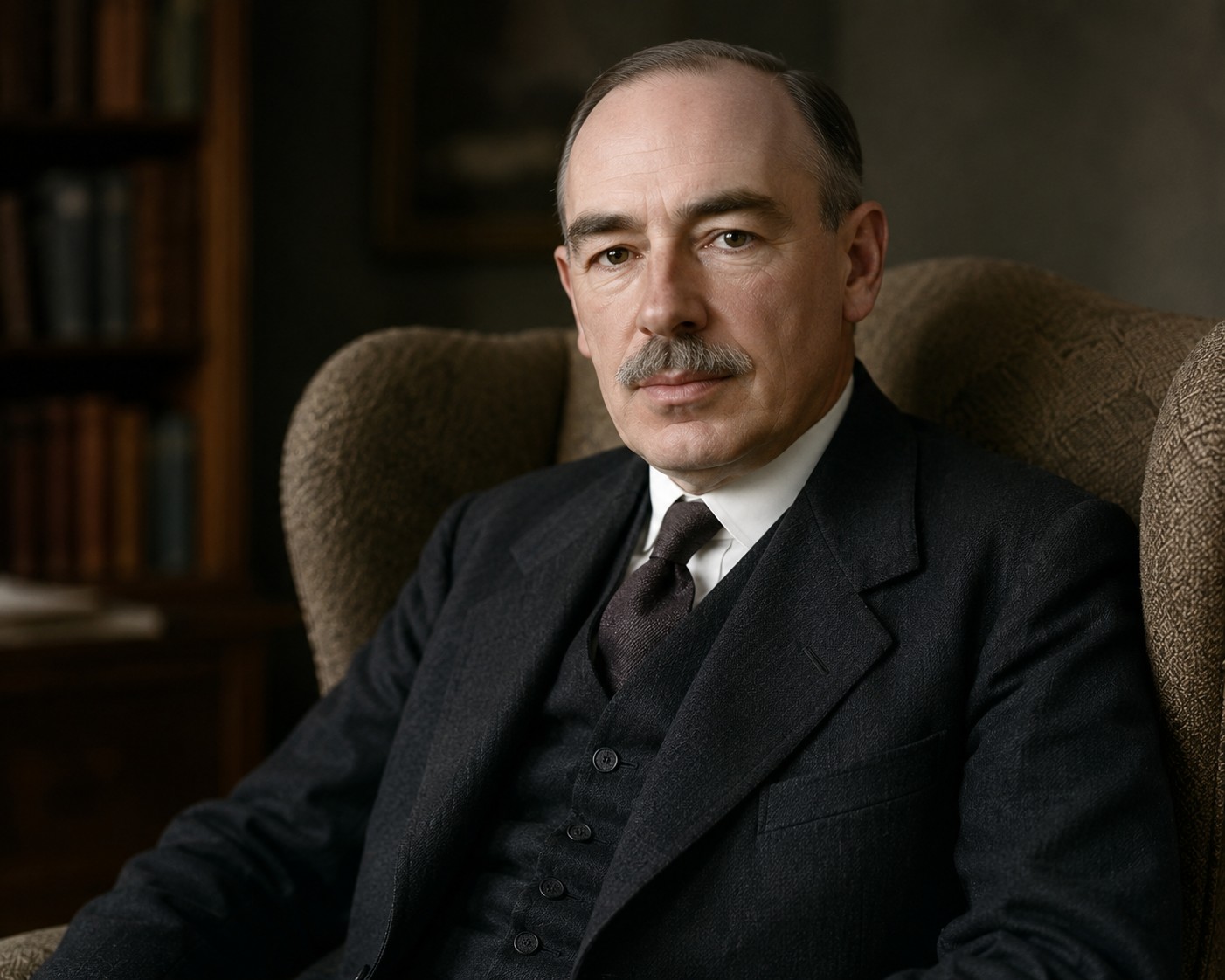
Exclusive WBO Times Interview with John Maynard Keynes
The State, Markets, Crisis, and the Future of Capitalism in the Age of Artificial Intelligence
Introduction
Few economists have exercised as profound an influence on modern economic policy as John Maynard Keynes. In the aftermath of the Great Depression, his ideas reshaped the intellectual foundations of economic governance and transformed the relationship between markets, governments, and society. In this interview, Keynes reflects on the defining challenges of the twenty-first century, including public debt, inflation, inequality, artificial intelligence, and the future of capitalism.
Part I: Capitalism and Economic Crises
Interviewer: Lord Keynes, when you look at the global economy today, what do you consider the greatest misunderstanding about capitalism?
John Maynard Keynes: The greatest misunderstanding is the belief that markets invariably possess an automatic mechanism that guides them swiftly and efficiently toward full equilibrium. Markets are extraordinary institutions, but they are not governed solely by mathematics. They are shaped by expectations, fears, confidence, uncertainty, and what I once described as animal spirits. Economic life is not a mechanical process; it is profoundly psychological. The central problem of modern economies is not that markets occasionally fail. It is that they may remain in a state of dysfunction for far longer than societies can comfortably endure.
Interviewer: If a financial crisis similar to that of 2008 were to occur again, what would your prescription be?
John Maynard Keynes: My answer would remain essentially unchanged. When private actors are unwilling to invest because uncertainty overwhelms confidence, the public sector must assume responsibility for sustaining aggregate demand. In such moments, the state becomes not a substitute for private enterprise, but a bridge between collapse and recovery. One of the most persistent fallacies in economics is the assumption that what is prudent for an individual must also be prudent for society. Collective attempts to save simultaneously during a downturn often deepen the very crisis they seek to avoid.
Part II: Debt, Inflation, and Public Policy
Interviewer: Many nations today carry historically high levels of public debt. Should this concern us?
John Maynard Keynes: Debt, in itself, is neither a virtue nor a vice. The relevant question is not how much a government owes, but what has been achieved through that borrowing. Debt used to finance productive investment—infrastructure, education, innovation, and future productive capacity—can strengthen a nation's prosperity. Debt accumulated merely to postpone structural problems is an entirely different matter. Economic judgment requires attention to purpose, not obsession with accounting figures in isolation.
Interviewer: What is your view on inflation?
John Maynard Keynes: Inflation is a serious concern, but so too is unemployment. The art of economic policy lies in recognizing which danger is most pressing at a particular moment. There are no eternal policy formulas. Circumstances change, and sound policy must adapt accordingly. The economist who seeks a universal answer to every problem is likely to misunderstand the nature of economic reality itself.
Part III: Inequality and Capital
Interviewer: Does the level of inequality in today's world concern you?
John Maynard Keynes: Very much so. Excessive inequality is not merely a moral issue; it is an economic one. A society in which wealth becomes excessively concentrated risks weakening the very foundations of effective demand upon which economic prosperity depends. A healthy economy requires broad participation in economic opportunity. Stability cannot indefinitely coexist with widening disparities in both wealth and prospects.
Part IV: Artificial Intelligence and the Future of Work
Interviewer: How do you assess the rise of artificial intelligence?
John Maynard Keynes: Many years ago, I wrote about what I termed technological unemployment—the possibility that our capacity to economize on labor would advance faster than our capacity to discover new uses for it. Artificial intelligence appears to be one of the most powerful manifestations of that phenomenon. Yet technological progress should not be feared in itself. The challenge is not whether productivity increases; the challenge is whether society possesses the institutions necessary to distribute the benefits of that productivity wisely.
Interviewer: Do you believe artificial intelligence will eliminate large numbers of jobs?
John Maynard Keynes: Undoubtedly, some occupations will disappear, just as others will emerge. The more important question is whether the gains from increased productivity will translate into broader prosperity or become concentrated within a narrow segment of society. Technology should reduce scarcity. It should not create new forms of exclusion.
Part V: The State and the Market
Interviewer: Your critics often argue that Keynesian economics leads to an excessively large state. How do you respond?
John Maynard Keynes: That criticism misunderstands my position. I never advocated replacing markets with government administration. On the contrary, I regarded market economies as powerful engines of innovation and wealth creation. My concern was that markets, left entirely to themselves during periods of severe instability, could produce outcomes that were socially and economically destructive. The purpose of intervention is not to abolish capitalism, but to preserve it from its own excesses and instabilities.
Final Question
Interviewer: If you could ask today's political and economic leaders only one question, what would it be?
John Maynard Keynes: I would not ask about quarterly growth figures. I would not ask about stock market valuations. Nor would I ask how rapidly technology is advancing. I would ask a simpler and more important question:
"Is the wealth we are creating building a more secure and prosperous society, or merely inflating the value of assets?"
The ultimate purpose of economics is not the accumulation of wealth for its own sake. The purpose of economics is to create the conditions under which human beings may live with dignity, security, opportunity, and freedom.
Closing Reflection:
The enduring relevance of Keynes lies in his recognition that prosperity depends not only on markets but also on confidence, institutions, and collective stability. In a world increasingly shaped by artificial intelligence, financial complexity, and geopolitical uncertainty, his central message remains remarkably contemporary:
Economic systems should be judged not by the wealth they generate alone, but by the society they make possible.