




Strategic Trade Corridors and the Future of Global Connectivity
Introduction: Why Trade Corridors Matter
Throughout history, economic power has often followed the world's major trade routes. From the ancient Silk Road linking Asia and Europe to the maritime routes that connected continents during the age of exploration, trade corridors have shaped the rise and decline of civilizations, empires, and economies. Today, despite digital transformation and technological innovation, geography remains a critical determinant of global commerce. More than 80 percent of world merchandise trade continues to move through maritime transportation networks, while rail, road, air, and multimodal corridors increasingly connect regional markets. Modern trade corridors are not merely infrastructure projects. They are strategic systems through which goods, capital, technology, energy, information, and influence flow across the global economy.
The New Geography of Global Trade
The traditional architecture of global trade was largely built around a small number of maritime chokepoints and industrial centers. However, the emergence of Asia as a manufacturing powerhouse, the growth of Africa and the Middle East, and the increasing importance of regional supply chains are reshaping global trade geography. Today, nations are investing heavily in logistics infrastructure, ports, railways, industrial zones, and digital connectivity to position themselves within future trade networks. Competition is no longer limited to producing goods; it increasingly involves becoming a gateway through which goods move. Countries that successfully position themselves within major trade corridors gain access to investment, logistics services, industrial development, and geopolitical influence.
The World's Most Strategic Trade Corridors
The Indo-Pacific Maritime Corridor
The Indo-Pacific region has become the center of global economic activity. Connecting East Asia, Southeast Asia, South Asia, the Middle East, Africa, and Europe, this maritime corridor carries a substantial share of global trade and energy flows. Its strategic importance extends beyond economics. It has become a focal point of geopolitical competition, supply chain security discussions, and infrastructure investment. The future of global commerce will be heavily influenced by developments within this corridor.
The Suez Canal Corridor
Suez Canal remains one of the most important trade gateways in the world. Serving as a critical link between Asia and Europe, it significantly reduces transportation times and logistics costs compared to alternative routes. Recent disruptions have highlighted the vulnerability of global supply chains to bottlenecks within key maritime chokepoints. The Suez corridor demonstrates how a single route can influence global inflation, shipping costs, and international trade flows.
The Belt and Road Economic Corridors
The Belt and Road Initiative represents one of the largest infrastructure and connectivity programs in modern history. Its network of ports, railways, highways, industrial zones, and logistics hubs seeks to strengthen connectivity across Asia, Europe, Africa, and parts of Latin America. Supporters view it as a catalyst for economic development and infrastructure modernization, while critics raise concerns regarding debt sustainability, strategic dependence, and geopolitical influence. Regardless of perspective, it is reshaping the geography of global trade.
The Middle Corridor
Increasing geopolitical uncertainty has elevated the importance of the so-called Middle Corridor connecting East Asia, Central Asia, the Caucasus region, and Europe. This route has gained attention as an alternative pathway linking Asian and European markets while reducing reliance on traditional northern routes. Countries across Central Asia and the South Caucasus increasingly view this corridor as an opportunity to strengthen their role within Eurasian trade networks. For many regional economies, the Middle Corridor represents both an economic and strategic opportunity.
The India–Middle East–Europe Economic Corridor (IMEC)
The India–Middle East–Europe Economic Corridor reflects the growing interest in diversified trade routes. The concept aims to connect South Asia, the Gulf region, and Europe through integrated transportation, logistics, energy, and digital infrastructure. If fully implemented, the corridor could become an important component of future supply chain diversification strategies. Its significance extends beyond commerce into broader questions of regional cooperation and economic integration.
Trade Corridors as Instruments of Geopolitical Influence
Trade corridors are increasingly becoming tools of geopolitical strategy. Infrastructure investments often generate long-term economic relationships, logistical dependencies, and strategic partnerships. Ports, railways, logistics hubs, and digital networks are no longer viewed solely as economic assets. They are increasingly considered components of national power. As a result, competition over connectivity is emerging as one of the defining characteristics of the modern international system. The countries that shape tomorrow's trade corridors may also shape tomorrow's economic order.
The Digital Trade Corridor Revolution
While physical infrastructure remains essential, digital connectivity is creating a new generation of trade corridors. Cross-border data flows, digital payments, e-commerce platforms, cloud infrastructure, and AI-driven logistics systems are increasingly influencing international commerce. Future trade competitiveness will depend not only on physical transportation capacity but also on digital infrastructure, cybersecurity, and data integration capabilities. The next generation of trade corridors will combine physical and digital connectivity into integrated commercial ecosystems.
A Critical Perspective: Infrastructure Alone Is Not Enough
Many governments view trade corridors primarily as infrastructure projects. However, history demonstrates that infrastructure alone does not guarantee economic success. Successful trade corridors require efficient customs systems, regulatory coordination, political stability, security, financial services, skilled human capital, and trusted institutions. Without these supporting elements, even the most ambitious infrastructure projects may fail to achieve their intended economic impact. Connectivity is ultimately about systems, not simply roads and ports.
WBO Executive Recommendations for International Traders
The World Business Organization (WBO) encourages international traders to incorporate trade corridor intelligence into their strategic planning processes. Businesses should continuously monitor emerging transportation routes, logistics hubs, regional infrastructure developments, and geopolitical trends that may affect market access and supply chain resilience. Companies are advised to diversify logistics pathways, avoid excessive dependence on a single corridor, and develop contingency plans for potential disruptions. WBO further recommends that traders explore opportunities within emerging corridors such as the Middle Corridor, Indo-Pacific networks, and new interregional connectivity initiatives. In an increasingly interconnected yet uncertain world, understanding trade corridors is no longer a logistical concern alone—it is a strategic necessity for sustainable international business growth.
Conclusion
Trade corridors have always been among the most powerful forces shaping economic history. Today, they remain critical to global prosperity, but their significance is expanding. They are becoming platforms for trade, investment, technology transfer, energy security, regional integration, and geopolitical influence. As the global economy enters a new phase of transformation, the competition to build, secure, and control strategic corridors will intensify. The future of global commerce will not be determined solely by what nations produce, but increasingly by how effectively they connect the world. In the twenty-first century, connectivity itself is becoming one of the most valuable forms of economic power.
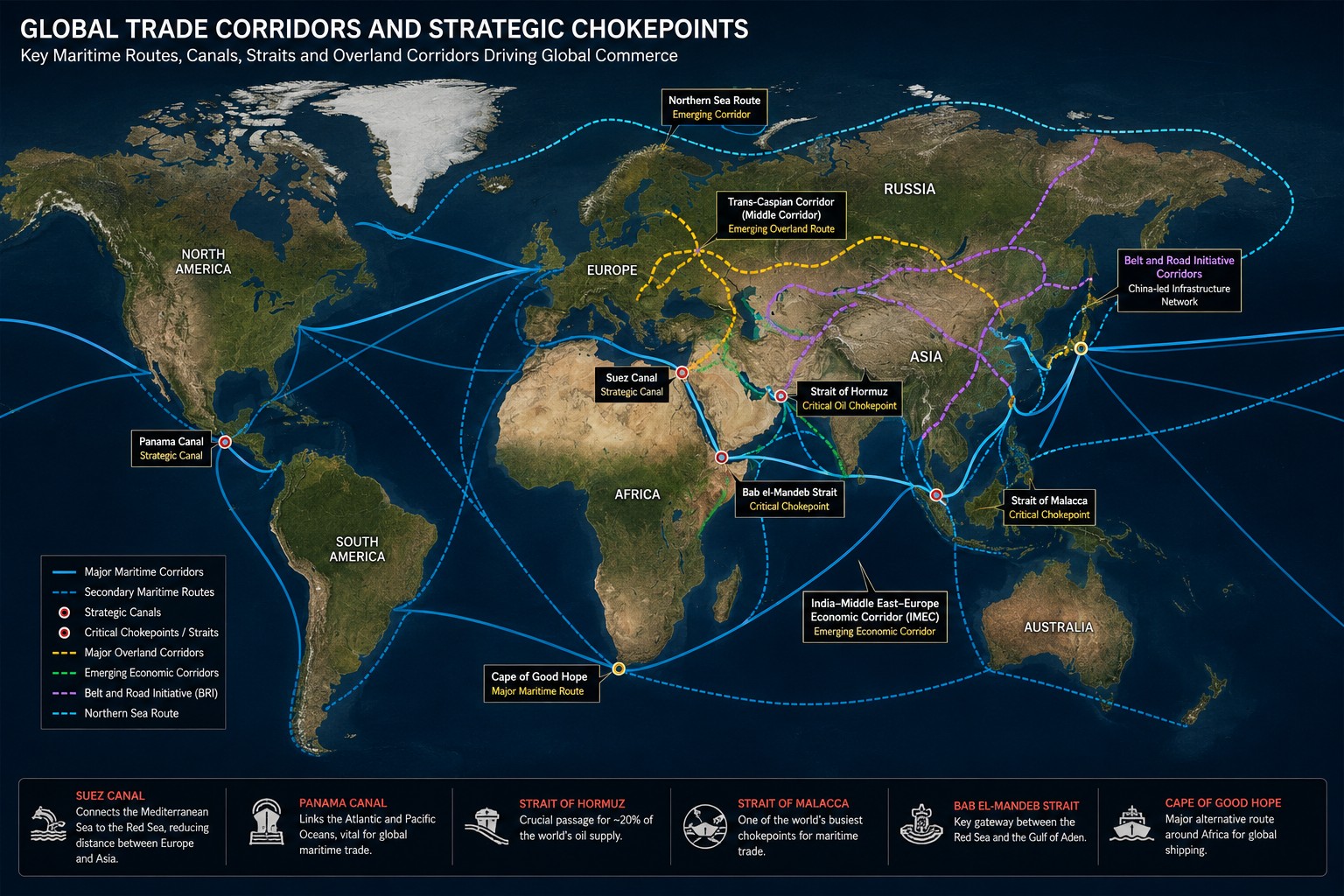
Global trade corridors are far more than transportation routes. They are strategic economic arteries that connect production centers, consumer markets, financial hubs, energy resources, and geopolitical interests. In the twenty-first century, control, development, and security of these corridors are becoming central factors in international trade, economic growth, and geopolitical influence.
Font Size
1x
Reading time: 6 min