




The Global Economy in an Era of Shifting World Order
For more than three decades, the global economy was largely shaped by an integrated international system characterized by expanding globalization, relatively open markets, and interconnected supply chains. Today, however, that model is undergoing one of the most profound transformations in modern history. Geopolitical tensions, technological rivalry, economic nationalism, and the emergence of new regional alliances are redefining the rules of global commerce. The world is not witnessing the end of globalization; it is witnessing its transformation.
One of the most significant challenges is the fragmentation of global supply chains. Companies that once optimized production based solely on efficiency are now prioritizing resilience, diversification, and geopolitical security. Concepts such as friend-shoring, near-shoring, and strategic decoupling have become central to corporate strategy, reflecting a shift from cost optimization to risk management.
At the same time, the global balance of economic power is becoming increasingly multipolar. Emerging economies are playing a greater role in international trade, investment, and technological innovation, while regional economic blocs are strengthening their influence. Rather than relying on a single dominant economic center, businesses must now navigate multiple regulatory systems, financial networks, and geopolitical interests simultaneously.
Technology is accelerating this transition. Artificial intelligence, digital infrastructure, advanced manufacturing, and data-driven commerce are reshaping competitive advantage across industries. Yet technological leadership is also becoming a source of geopolitical competition, with governments viewing semiconductors, cybersecurity, rare earth minerals, and AI capabilities as strategic national assets rather than purely commercial products.
This evolving environment presents both risks and opportunities. Businesses that continue to rely on outdated assumptions about stable global markets may face increasing uncertainty. Those that invest in strategic flexibility, diversified partnerships, cultural intelligence, and technological adaptation will be better positioned to succeed in a fragmented yet highly interconnected global economy.
The defining challenge of the coming decade will not simply be adapting to economic change, it will be understanding the new architecture of global power. Organizations that recognize how geopolitics, technology, trade, and culture intersect will be best equipped to transform uncertainty into long-term competitive advantage.
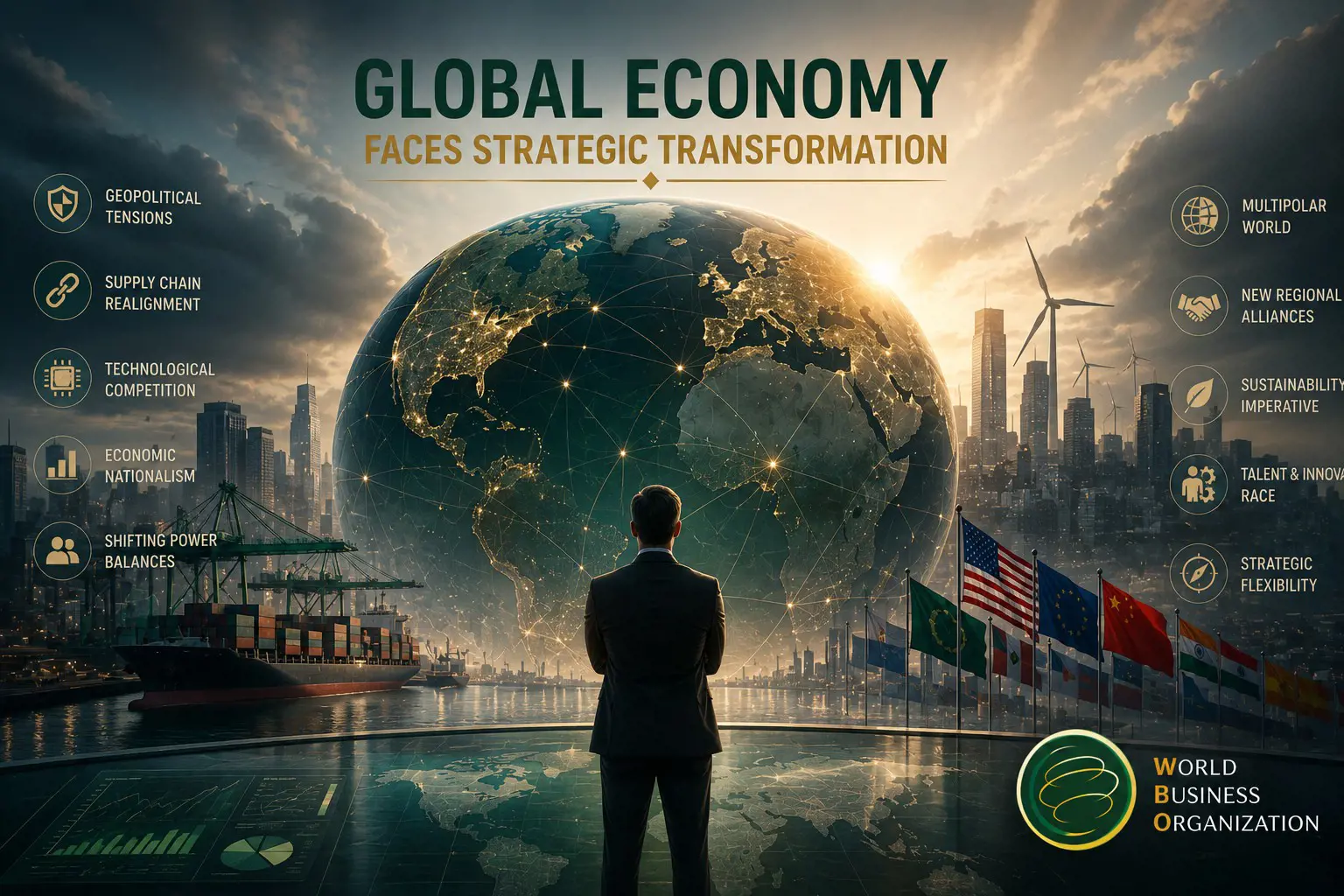
The global economy is entering a new era shaped by geopolitical shifts, technological competition, and the emergence of a multipolar world. This article explores how changing global dynamics are redefining trade, investment, and business strategy, and why adaptability has become the most valuable economic asset.
Font Size
1x
Reading time: 2 min