




Historical Intelligence Interview with Winston Churchill:
Winston Churchill on Global Crises, Leadership, Hope, and the Future of Nations
Interviewer: Sir Winston, how should leaders respond to global crises?
Winston Churchill: The first duty of a leader in times of crisis is not to solve the crisis immediately. It is to understand it clearly. Many leaders throughout history have failed not because they lacked resources, but because they refused to confront reality. They preferred comforting illusions to uncomfortable truths. During the war, I learned that people could endure hardship. They can endure scarcity. They can endure sacrifice. They can even endure danger. What they cannot endure is confusion, uncertainty, and deception. A leader facing a crisis must accomplish three tasks. First, he must see reality. Second, he must prepare his people for the difficulties ahead. Third, he must offer a vision of victory. Blind optimism is dangerous. Paralyzing pessimism is equally destructive. The task of leadership is to recognize reality without surrendering to it.
Interviewer: What role does hope play in leadership and management?
Churchill: Hope is not an emotion. It is a strategic asset. Many politicians and executives mistakenly believe that hope is created through promises. It is not. Hope emerges when people believe they are being led by someone who understands the path forward, even when that path is steep and difficult. During Britain's darkest hours, I never told my countrymen that the road would be easy. Quite the contrary. I spoke openly of blood, toil, tears, and sweat. Yet they endured because they believed there was a destination beyond the struggle. Hope without truth becomes propaganda. Truth without hope becomes despair. Leadership requires the wisdom to balance both.
Interviewer: What do you consider the greatest threat facing the world today?
Churchill: If I were to survey the modern world, I would not identify a single nation, army, or ideology as the greatest threat. Rather, I would point to something more fundamental: The weakening of civilization's will to defend its own values. Civilizations rarely collapse because their enemies become stronger. More often, they decline because they lose confidence in themselves, their principles, and their responsibilities. Alongside this challenge, I see three additional dangers of great consequence. The intensifying rivalry among major powers. The misuse of emerging technologies, including artificial intelligence. And the gradual erosion of public trust in institutions. A world in which technology advances faster than wisdom will never be a secure world.
Interviewer: If you were leading a nation today, what would be your highest priority?
Churchill: Many would expect me to answer military strength. Others might expect me to answer with economic growth. My answer would be different. National resilience. A successful nation is not one that merely prospers. It can endure adversity. If an economy is strong but society is fragile, the nation remains vulnerable. If the military is powerful but industry is weak, the nation remains vulnerable. If technology is advanced but public trust has collapsed, the nation remains vulnerable. Therefore, my foremost priority would be to build a nation capable of withstanding economic shocks, political turbulence, technological disruption, and security threats. The twenty-first century will belong not simply to those who grow, but to those who endure.
Interviewer: Of the British leaders who came after you, whom do you regard as the most capable?
Churchill: History must judge leaders within the context of their own age. Every statesman is, to some degree, a product of his circumstances. However, if I were asked to identify those who left the deepest mark upon Britain's modern history, I would mention several names. Margaret Thatcher demonstrated a rare willingness to undertake painful reforms when many preferred inaction. Whether one agrees with her policies or not, her determination and courage are beyond dispute. Clement Attlee deserves equal recognition. If my role was to lead Britain through war, Attlee's was to rebuild Britain after it. Statesmanship in peace can be as demanding as leadership in conflict. Tony Blair successfully adapted Britain to the realities of globalization and the emerging economic order of his time, though history will continue to debate aspects of his foreign policy. Yet, if compelled to choose a single name, I would most likely choose Margaret Thatcher. Not because she was always correct. But because she possessed a quality that history repeatedly rewards: The courage to make difficult decisions when they are required.
Interviewer: There is a story often told that you once described politics through a shocking act involving your beloved cat. If such a story were true, what would you have felt, and would you still define politics in the same way today?
Churchill: First, let us distinguish legend from history.
Many stories are told about public figures. Some contain truth. Others merely survive because they are memorable. But let us address the principle behind the question. If politics requires the suffering of the innocent merely to illustrate a lesson, then politics has already lost its moral purpose. Too many people define politics as manipulation, intrigue, and the sacrifice of others. That definition is inadequate. Politics, at its highest level, is not the art of choosing between good and evil. Such choices are comparatively easy. Politics is the art of choosing between imperfect alternatives. The burden of leadership is that one is often forced to choose between difficult options, none of which is entirely satisfactory. If I were asked today to describe politics through an image, I would choose a different one. Politics is like commanding a ship in the midst of a violent storm. The passengers see only the waves. The critics see only the captain's mistakes. But the captain must simultaneously consider the wind, the currents, the destination, the condition of the vessel, and the safety of every soul aboard. He cannot wait for calm seas before making decisions. He must decide in the storm. And if I were asked to define politics in a single sentence, I would say:
Politics is the art of guiding a nation safely through visible dangers while preparing it for dangers not yet visible.
For in my experience, the greatest failures of statesmen rarely arise from threats they can see. They arise from threats they refuse to see. And with the knowledge of today's world, I would no longer explain politics through shock or provocation. I would explain it through a single word:
Responsibility.
For power without responsibility becomes tyranny. And politics without responsibility becomes mere theatre.
Final Message to the Leaders of Our Time:
"The future does not belong to those who predict events correctly. It belongs to those who possess the courage to act when events become difficult."
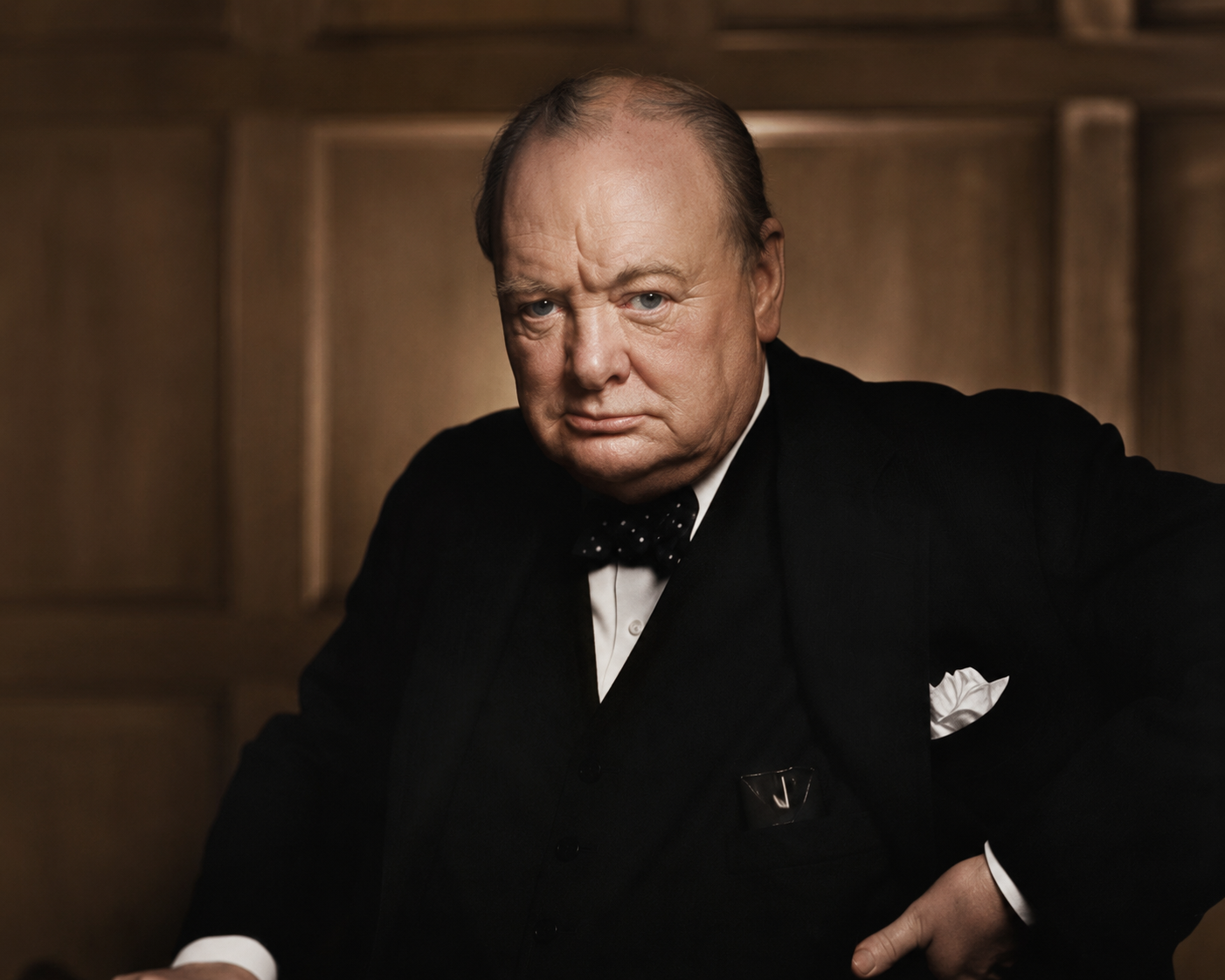
What does it take to lead through uncertainty, conflict, and global transformation? In this exclusive interview, Winston Churchill reflects on leadership, national resilience, public trust, and the defining threats of the twenty-first century. His enduring perspective provides a powerful framework for understanding the demands of leadership in an age of unprecedented change.
Font Size
1x
Reading time: 6 min