




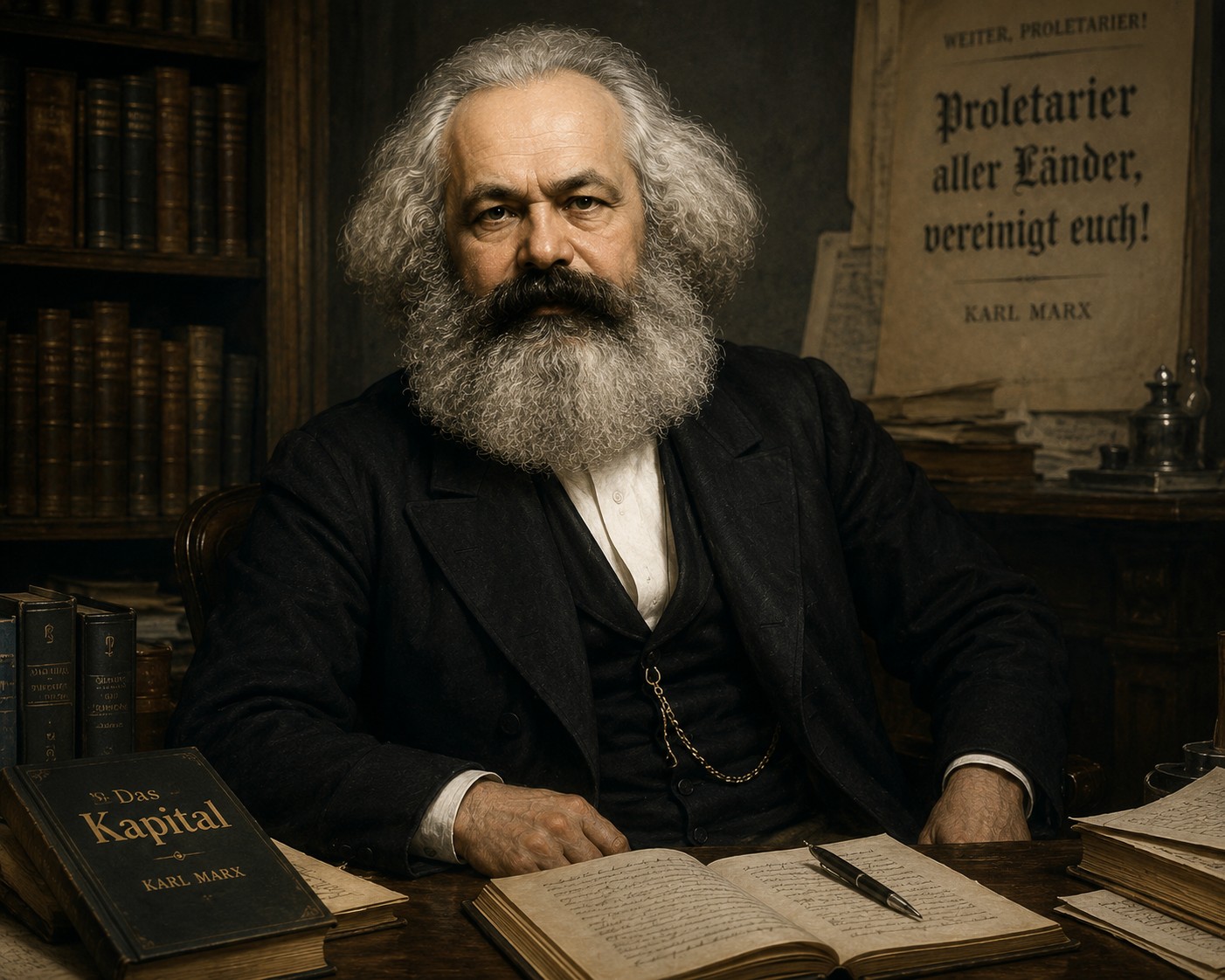
Exclusive WBO Times Interview with Karl Marx
Capital, Power, Technology, and the Future of Humanity
Introduction
More than a century after my death, the world remains haunted by questions that emerged from the very contradictions I sought to uncover: the concentration of wealth, the domination of capital, the nature of labor, and the relationship between economic power and political authority. Yet the contemporary world—defined by artificial intelligence, digital platforms, global finance, and data-driven capitalism—is far more technologically sophisticated than the industrial society I analyzed. The forms have changed. The essence has not.
Part I: Contemporary Capitalism
Interviewer: Mr. Marx, when you observe the global economy today, do you believe your predictions about capitalism have been fulfilled?
Karl Marx: History has confirmed certain tendencies that I identified within the capitalist mode of production. Capital has become increasingly concentrated. Production has expanded beyond national boundaries. Markets have penetrated nearly every sphere of social life. The relentless pursuit of accumulation has transformed the world into a single interconnected economic system. Yet capitalism has also demonstrated a remarkable capacity for adaptation. Through reforms, welfare institutions, democratic concessions, and technological advancement, it has repeatedly postponed crises that many believed would prove fatal. But postponement is not resolution. Contradictions delayed are not contradictions eliminated.
Interviewer: What do you consider to be capitalism’s greatest strength?
Karl Marx: It's unparalleled capacity to develop the productive forces of society. No previous social order unleashed such extraordinary levels of innovation, scientific advancement, industrial expansion, and material production. I never denied this fact. Indeed, I regarded it as one of capitalism’s most revolutionary characteristics. My criticism was never directed against progress itself. My question was always: who owns the fruits of that progress, and who exercises power over the conditions under which it is produced?
Part II: Artificial Intelligence and Technology
Interviewer: How do you assess artificial intelligence?
Karl Marx: Artificial intelligence represents perhaps the most advanced stage in the historical process by which human knowledge becomes incorporated into capital. The machines of the Industrial Revolution absorbed human physical labor. The intelligent systems of today increasingly absorb cognitive labor. What we are witnessing is not merely technological development but a transformation in the relationship between labor and capital. The essential question remains unchanged: Who owns these instruments of production? If ownership and control remain concentrated in the hands of a small elite, artificial intelligence may generate levels of inequality far beyond anything previously experienced in human history.
Interviewer: Do you believe artificial intelligence will bring about the end of human labor?
Karl Marx: Not necessarily. The fundamental issue is not the disappearance of labor, but the transformation of humanity’s relationship to labor. The tragedy is not that human beings may one day work less. The tragedy would be if the benefits of that liberation were appropriated by a minority while the majority remained dependent upon structures they neither control nor own. Technology possesses the potential to expand human freedom. Yet under unequal relations of ownership, it may equally become a new instrument of domination.
Part III: Technology Corporations and Economic Power
Interviewer: Today, some technology corporations appear more powerful than many nation-states. Does this surprise you?
Karl Marx: Not in the slightest. What you describe is merely the continuation of a tendency inherent within capitalism itself: the concentration and centralization of capital. The instruments have changed, but the logic remains. In the nineteenth century, factories stood at the center of economic power. Today, data, algorithms, digital platforms, and information networks occupy that position. Economic power inevitably seeks social influence, and social influence inevitably seeks political authority.
Part IV: The State, Democracy, and Authority
Interviewer: How do you view the role of the state in the twenty-first century?
Karl Marx: Historical experience has shown that the relationship between the state, capital, and society is more complex than many simplistic interpretations of my work assumed. Yet one principle remains indispensable: No serious discussion of democracy can ignore the distribution of economic power. Every society must ask a fundamental question: Who controls the productive resources upon which collective life depends? Without confronting this question, discussions of liberty and democracy risk becoming abstractions detached from material reality.
Part V: On Twentieth-Century Communism
Interviewer: Many argue that the experience of the Soviet Union and other communist states disproved your theories. How would you respond?
Karl Marx: No serious thinker should exempt his own ideas from historical judgment. Many regimes established in my name became characterized by excessive centralization, political repression, and economic inefficiency. These realities cannot simply be dismissed. Yet one must distinguish between a body of theory and every historical regime that claims to represent it. The decisive question is not whether governments invoked my name. The decisive question is whether the problems I identified—concentrated power, inequality, exploitation, and the accumulation of capital—have disappeared. Looking at the contemporary world, I leave that judgment to history.
Final Question
Interviewer: If you could ask today’s political and economic leaders only one question, what would it be?
Karl Marx: I would not ask how much the economies have grown. I would not ask how much the stock market has risen. I would not ask how rapidly technology has advanced. I would ask only this:
“Who owns the future?”
For every debate about artificial intelligence, trade, technological innovation, economic growth, or global development ultimately returns to the same issue. History is shaped not merely by those who create the future, but by those who possess the power to own it.