




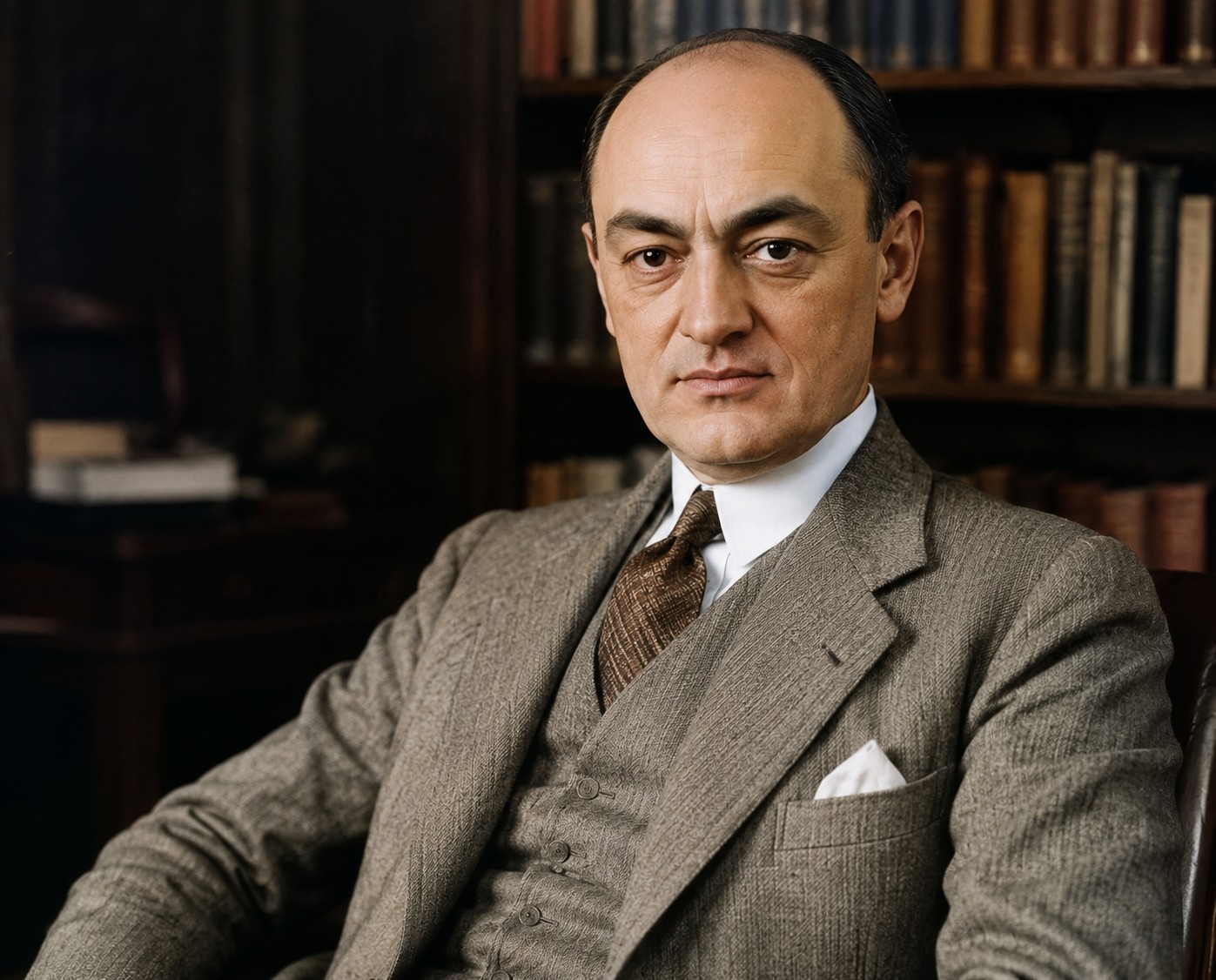
Exclusive WBO Times Interview with Joseph Schumpeter
Innovation, Creative Destruction, Artificial Intelligence, and the Future of Capitalism
Introduction:
Few economists have understood the forces of economic transformation as profoundly as Joseph Schumpeter. While many focused on markets, capital, or government policy, Schumpeter placed innovation and entrepreneurship at the center of economic evolution. His concept of creative destruction remains one of the most powerful frameworks for understanding technological change, industrial disruption, and long-term economic growth. In this exclusive interview, Schumpeter reflects on the defining challenges of the twenty-first century, from artificial intelligence and digital monopolies to entrepreneurship, globalization, and the future of capitalism itself.
Part I: Capitalism and Its Evolution
Interviewer: Professor Schumpeter, what is the greatest misunderstanding about capitalism today?
Joseph Schumpeter: The greatest misunderstanding is the belief that capitalism is primarily a system of equilibrium. It is not. Capitalism is fundamentally a process of perpetual transformation. Its essence is not stability, but change. Economists often focus on prices, markets, and resource allocation, but these are secondary phenomena. The true engine of capitalism is innovation—the continuous creation of new products, new industries, new technologies, and new ways of organizing economic life. A capitalist economy is never truly at rest. It survives by reinventing itself.
Interviewer: Many people see economic disruption as a problem. You viewed it differently. Why?
Schumpeter: Because disruption is often the price of progress. Every breakthrough destroys something that came before it. Railways displaced older transport systems. Automobiles transformed entire industries. Computers reshaped offices and factories. The digital economy disrupted countless business models. This process, which I called creative destruction, is not a flaw within capitalism—it is its defining characteristic. The tragedy is not that old structures disappear. The tragedy would be a society that becomes incapable of creating new ones.
Part II: Artificial Intelligence and the New Wave of Innovation
Interviewer: Is artificial intelligence the greatest example of creative destruction in modern history?
Schumpeter: It may well be. Artificial intelligence is not simply another technology. It is a general-purpose innovation capable of transforming nearly every sector simultaneously. It affects production, finance, healthcare, education, logistics, communication, and even knowledge creation itself. What makes AI unique is that it challenges not only physical labor but also many forms of intellectual labor. Consequently, its disruptive power may exceed that of previous industrial revolutions.
Interviewer: Should society fear this transformation?
Schumpeter: Fear is understandable but often misplaced. History teaches us that societies rarely suffer because innovation occurs. They suffer because institutions fail to adapt to innovation. The critical question is not whether AI will change the economy. It certainly will. The real question is whether governments, educational systems, and businesses can evolve quickly enough to manage that change.
Part III: Entrepreneurs and Economic Power
Interviewer: Who is more important to economic progress: governments, investors, or entrepreneurs?
Schumpeter: Without hesitation: entrepreneurs. Capital is important. Institutions are important. Governments are important. But none of them initiate economic transformation. The entrepreneur is the individual who combines resources in novel ways and introduces change into the economic system. Entrepreneurs disrupt routines, challenge established interests, and create entirely new markets. Economic history is ultimately the history of entrepreneurial revolutions.
Interviewer: Today, some technology corporations dominate entire industries. Would you consider this a threat?
Schumpeter: Potentially. Large firms are not necessarily enemies of innovation. In some cases, they possess the resources required for large-scale research and technological development. The danger emerges when dominant firms cease innovating and begin protecting their position through control rather than creativity. When market power becomes a substitute for innovation, the process of creative destruction slows, and economic dynamism begins to decline. The greatest threat to capitalism is not competition. It is the absence of competition.
Part IV: Globalization and the Future Economy
Interviewer: How do you view the future of globalization?
Schumpeter: Globalization is evolving rather than disappearing. The next phase of globalization will be driven less by the movement of physical goods and more by the movement of knowledge, data, technology, and intellectual capital. In the industrial era, economic power belonged primarily to those who controlled factories and resources. In the emerging era, power will increasingly belong to those who control innovation ecosystems. The world's most valuable resource is no longer oil, land, or machinery. It is the capacity to generate and apply new ideas.
Part V: The Future of Capitalism
Interviewer: In your writings, you suggested that capitalism might eventually undermine itself. Do you still believe that?
Schumpeter: Yes, although perhaps not for the reasons many assume. Capitalism's greatest strength is its ability to generate unprecedented prosperity. Yet that very success can create large bureaucratic structures, concentrations of power, and social expectations that gradually weaken the entrepreneurial spirit upon which capitalism depends. The danger is not economic collapse. The danger is institutional stagnation. A society may become wealthy enough to forget the forces that created its wealth in the first place.
Final Question
Interviewer: If you could ask today's business leaders only one question, what would it be?
Schumpeter: I would not ask how much market share they control. I would not ask how much capital they have raised. I would not ask how valuable their companies have become.
I would ask only this:
"What are you creating that did not exist before?"
Because economic progress is not measured by the preservation of existing wealth. It is measured by the creation of new possibilities. The future belongs not to those who manage yesterday most efficiently, but to those who invent tomorrow.