




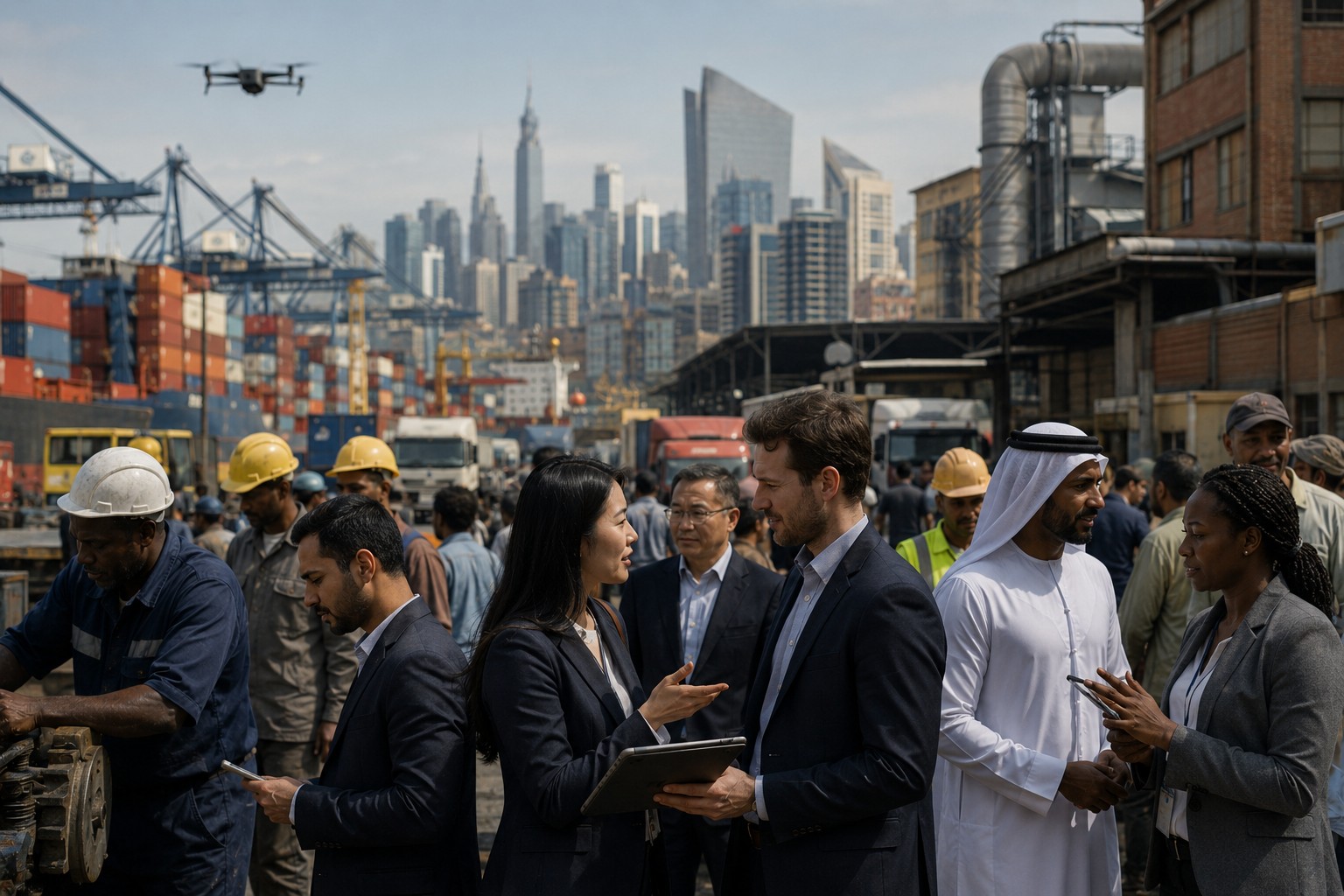
Understanding the Forces Reshaping the World Economy
Introduction: A New Era for Global Markets
For much of the past three decades, global markets operated under a relatively predictable model characterized by increasing globalization, expanding supply chains, growing financial integration, and rising international trade. Businesses could generally assume that markets would become more interconnected, capital would flow freely, and economic efficiency would remain the primary driver of global commerce. Today, that assumption is being challenged. Global markets are no longer defined solely by economics. Political considerations, technological competition, national security concerns, climate pressures, and shifting consumer expectations are increasingly influencing how markets function. The result is a more complex and dynamic environment where opportunities and risks coexist at unprecedented levels. The world is not witnessing the end of globalization; rather, it is witnessing the evolution of globalization into a more fragmented, strategic, and multipolar form.
The Rise of a Multipolar Economic Landscape
One of the most significant developments in global markets is the redistribution of economic influence. For decades, economic power was concentrated in a relatively small number of advanced economies. Today, emerging markets are playing an increasingly important role in global production, consumption, innovation, and investment. New commercial corridors are emerging across Asia, the Middle East, Africa, and Latin America. Regional trade agreements, infrastructure projects, and investment partnerships are creating alternative centers of economic gravity. This transition is reshaping market opportunities. Businesses that focus exclusively on traditional economic centers risk overlooking some of the fastest-growing consumer markets, investment destinations, and innovation ecosystems of the coming decades.
Technology as the Primary Market Disruptor
Technology has become one of the most influential forces shaping global markets. Artificial intelligence, automation, advanced manufacturing, biotechnology, digital finance, and data-driven business models are transforming industries at unprecedented speed. Competitive advantage increasingly depends on knowledge, innovation, and technological adaptability rather than solely on physical assets. Entire sectors are being redefined. Traditional business models face disruption from digital platforms, while new industries emerge around technologies that were barely imaginable a decade ago. Markets are rewarding agility and punishing inertia. The most valuable companies in the world are increasingly those that control information, networks, and technological ecosystems rather than simply producing physical goods.
The Reconfiguration of Global Supply Chains
Recent global disruptions have exposed vulnerabilities within highly concentrated supply chains. Businesses are increasingly moving away from a model based solely on cost optimization and toward one focused on resilience, diversification, and strategic security. Companies are reassessing supplier relationships, manufacturing locations, transportation routes, and inventory strategies. Concepts such as nearshoring, friend-shoring, regionalization, and supply chain resilience have become central to corporate strategy. The future of global markets will likely be shaped by a balance between efficiency and security. Organizations that successfully manage this balance will possess a significant competitive advantage.
The Consumer Is Changing
Global consumers are evolving in ways that are transforming markets. Rising digital connectivity has increased transparency, accelerated information flows, and expanded consumer choice. At the same time, younger generations are placing greater emphasis on sustainability, authenticity, ethical practices, and social responsibility. Consumer decisions are increasingly influenced not only by price and quality but also by trust, reputation, environmental performance, and corporate values. This shift is forcing organizations to rethink branding, product development, customer engagement, and long-term business strategy.In many sectors, reputation is becoming as important as production capacity.
Geopolitics and Market Uncertainty
One of the defining characteristics of modern global markets is the growing influence of geopolitics. Trade disputes, sanctions, regional conflicts, technological competition, and strategic rivalries are increasingly affecting investment decisions and market behavior. Businesses can no longer separate economic analysis from geopolitical analysis. Market access, supply chain stability, regulatory environments, and investment opportunities are all being influenced by political developments. Companies that ignore geopolitical risk may find themselves exposed to disruptions that traditional market analysis fails to anticipate. Understanding political dynamics is becoming an essential component of market intelligence.
Sustainability as an Economic Driver
Environmental and sustainability considerations are moving from the margins of business strategy to the center of market decision-making. Governments, investors, consumers, and financial institutions are placing increasing emphasis on sustainable growth models, resource efficiency, carbon reduction, and responsible business practices. This transition is creating both challenges and opportunities. Industries that successfully adapt to sustainability requirements may gain access to new markets, investment flows, and competitive advantages. Those that fail to adapt risk regulatory pressures, reputational damage, and declining market relevance. Sustainability is no longer solely an environmental issue; it has become a market force.
A Critical Perspective: The End of Predictability
Perhaps the most important feature of today's global markets is the decline of predictability. Traditional assumptions about economic integration, political stability, and technological change are being continuously challenged. Market cycles are becoming more complex, and unexpected disruptions are increasingly common. However, uncertainty should not be viewed solely as a threat. Periods of transformation often create extraordinary opportunities for organizations capable of anticipating change and adapting quickly. History shows that many of the world's most successful businesses emerged during times of disruption rather than stability. The challenge is not to eliminate uncertainty but to develop the intelligence and resilience required to operate within it.
WBO Executive Recommendations for International Traders
The World Business Organization (WBO) recommends that international traders adopt a forward-looking market intelligence strategy focused on identifying structural trends rather than reacting solely to short-term events. Businesses should continuously monitor geopolitical developments, technological innovations, consumer behavior shifts, regulatory changes, and emerging economic corridors. Traders are encouraged to diversify markets, suppliers, financial partners, and logistics networks to strengthen resilience against unexpected disruptions. WBO further advises companies to invest in cultural intelligence, digital transformation, sustainability readiness, and strategic forecasting capabilities. In a rapidly evolving global marketplace, success will increasingly belong to organizations that can anticipate change, adapt quickly, and transform uncertainty into opportunity.
Conclusion
Global markets are entering a new phase defined by transformation rather than stability. Technology is redefining industries. Geopolitics is reshaping trade relationships. Consumers are changing expectations. New economic centers are emerging. Sustainability is becoming a competitive factor. Financial flows are becoming increasingly interconnected. Together, these forces are creating a global marketplace that is more complex, more competitive, and more dynamic than at any previous point in modern history. For businesses, the key question is no longer whether change is coming. The question is whether they are prepared to understand it, adapt to it, and capitalize on the opportunities it creates. In the emerging global economy, market intelligence, adaptability, and strategic foresight will be among the most valuable assets any organization can possess.
Dr. Luca Bianchi
Member of the R&D department