




The New Economics of Global Markets
For much of modern economic history, markets were understood through relatively straightforward frameworks. Supply and demand, production capacity, labor costs, interest rates, and capital flows were considered the primary forces shaping economic outcomes. While these fundamentals remain important, the architecture of global markets is undergoing a profound transformation. A new economic paradigm is emerging, one in which data, technology, trust, behavioral intelligence, and geopolitical influence increasingly determine competitive advantage.
The traditional economy was largely built around tangible assets. Nations accumulated wealth through natural resources, industrial production, infrastructure, and physical trade networks. Today, however, some of the world's most valuable organizations derive their strength not from factories or commodities, but from information, digital platforms, intellectual property, and network effects. Economic value is increasingly being created through the ability to collect, interpret, and utilize information more effectively than competitors.
At the same time, the growing influence of artificial intelligence is fundamentally altering the nature of economic decision-making. Businesses now possess unprecedented capabilities to analyze markets, predict consumer behavior, optimize supply chains, and identify emerging opportunities. Yet paradoxically, as information becomes more abundant, human judgment becomes more valuable. Competitive advantage is shifting from simply possessing data to interpreting it correctly within complex economic, cultural, and geopolitical contexts.
Another defining feature of the new global economy is the increasing importance of behavioral factors. Classical economic models often assumed that individuals act rationally. In reality, markets are shaped by perceptions, emotions, expectations, narratives, and collective psychology. Consumer behavior, investment decisions, political sentiment, and even financial market volatility are frequently driven by psychological forces rather than purely rational calculations. As a result, behavioral economics is moving from the margins of economic theory toward the center of strategic decision-making.
Trust is also emerging as a critical economic asset. In an age characterized by information overload, artificial intelligence, and digital interactions, credibility has become a scarce and valuable resource. Businesses, institutions, and even nations increasingly compete on their ability to establish trust with customers, investors, partners, and stakeholders. Reputation, transparency, governance quality, and ethical conduct are becoming measurable economic advantages rather than merely desirable qualities.
Simultaneously, global markets are becoming more deeply influenced by geopolitical realities. For decades, globalization was primarily driven by efficiency and cost optimization. Today, resilience, security, and strategic autonomy are becoming equally important considerations. Supply chains are being redesigned, trade routes are being reevaluated, and investment decisions are increasingly shaped by geopolitical risk assessments. Economic power is no longer determined solely by productivity; it is also influenced by technological sovereignty, resource security, and strategic positioning within global networks.
Perhaps the most significant shift is the emergence of what can be described as an economy of ecosystems rather than individual enterprises. Businesses no longer compete as isolated organizations. Instead, they operate within interconnected networks of suppliers, technology providers, financial institutions, governments, research centers, and customers. Success increasingly depends on the ability to build, manage, and participate in these ecosystems. In such an environment, collaboration often becomes as important as competition.
Looking ahead, the most successful organizations will be those capable of integrating multiple dimensions of intelligence. Financial intelligence, technological intelligence, behavioral intelligence, geopolitical intelligence, and cultural intelligence must work together within a unified strategic framework. Markets are no longer driven by economics alone; they are influenced by a complex interaction of technology, psychology, politics, culture, and trust.
The new economics of global markets, therefore, represent more than a shift in business strategy, it reflects a transformation in how value itself is created. The organizations, investors, and nations that recognize this transition early will be better positioned to navigate uncertainty, identify emerging opportunities, and build sustainable competitive advantages in the decades ahead.
WBO Executive Recommendations
The World Business Organization (WBO) encourages international traders, investors, and business leaders to expand their strategic perspective beyond traditional economic indicators. Success in the emerging global economy requires understanding not only markets and finance, but also trust dynamics, cultural behavior, geopolitical developments, technological disruption, and ecosystem-based competition. Organizations should invest in behavioral intelligence, geopolitical monitoring, reputation management, and AI-enabled decision support systems while strengthening cross-border partnerships and institutional trust. In the new economics of global markets, sustainable success will belong to those who can combine technological capability with human insight and strategic adaptability.
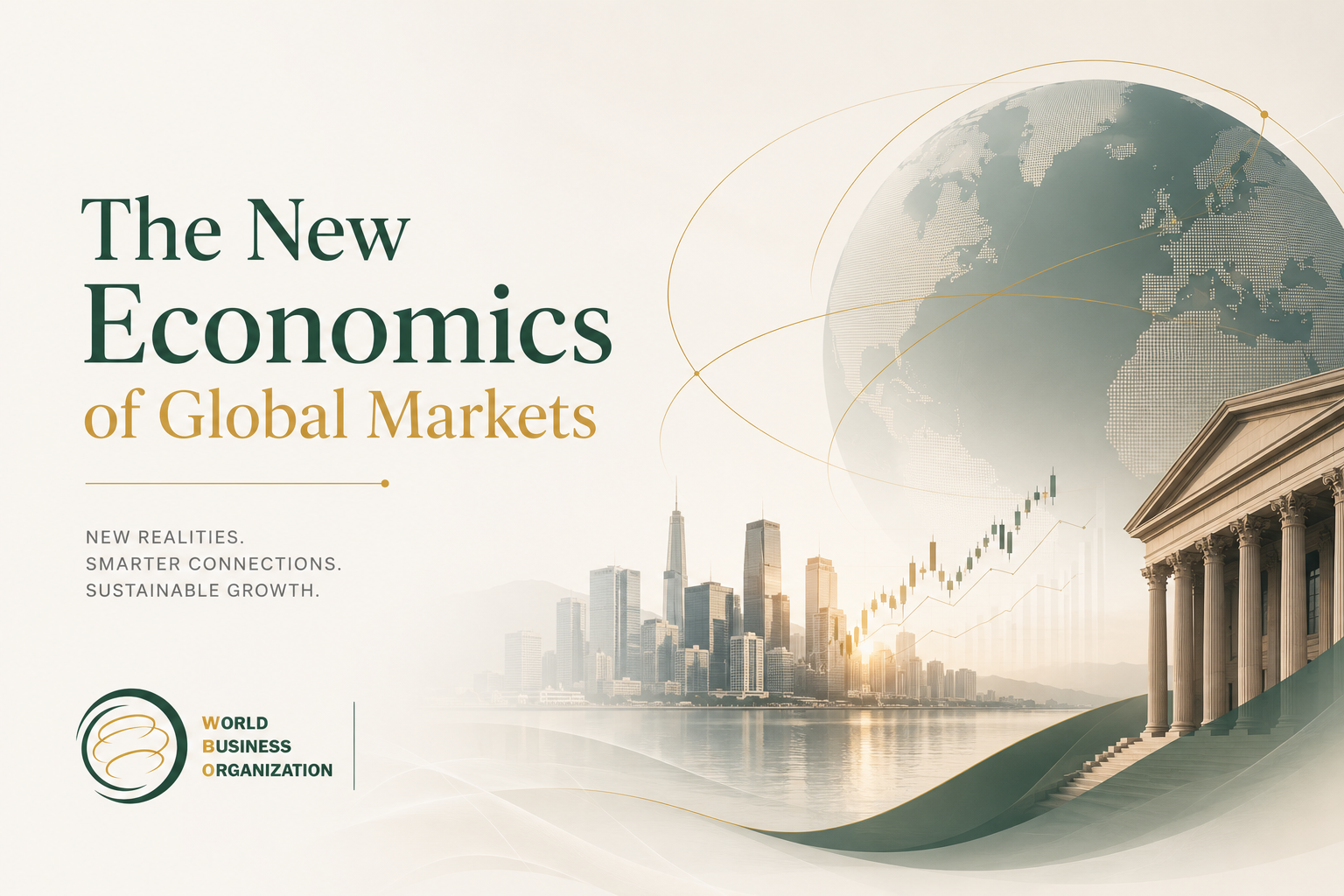
Global markets are entering a new economic era where data, trust, technology, and behavioral intelligence are becoming as important as capital, labor, and natural resources. Understanding this transformation is essential for businesses seeking to remain competitive in an increasingly interconnected and unpredictable world.
Font Size
1x
Reading time: 4 min