



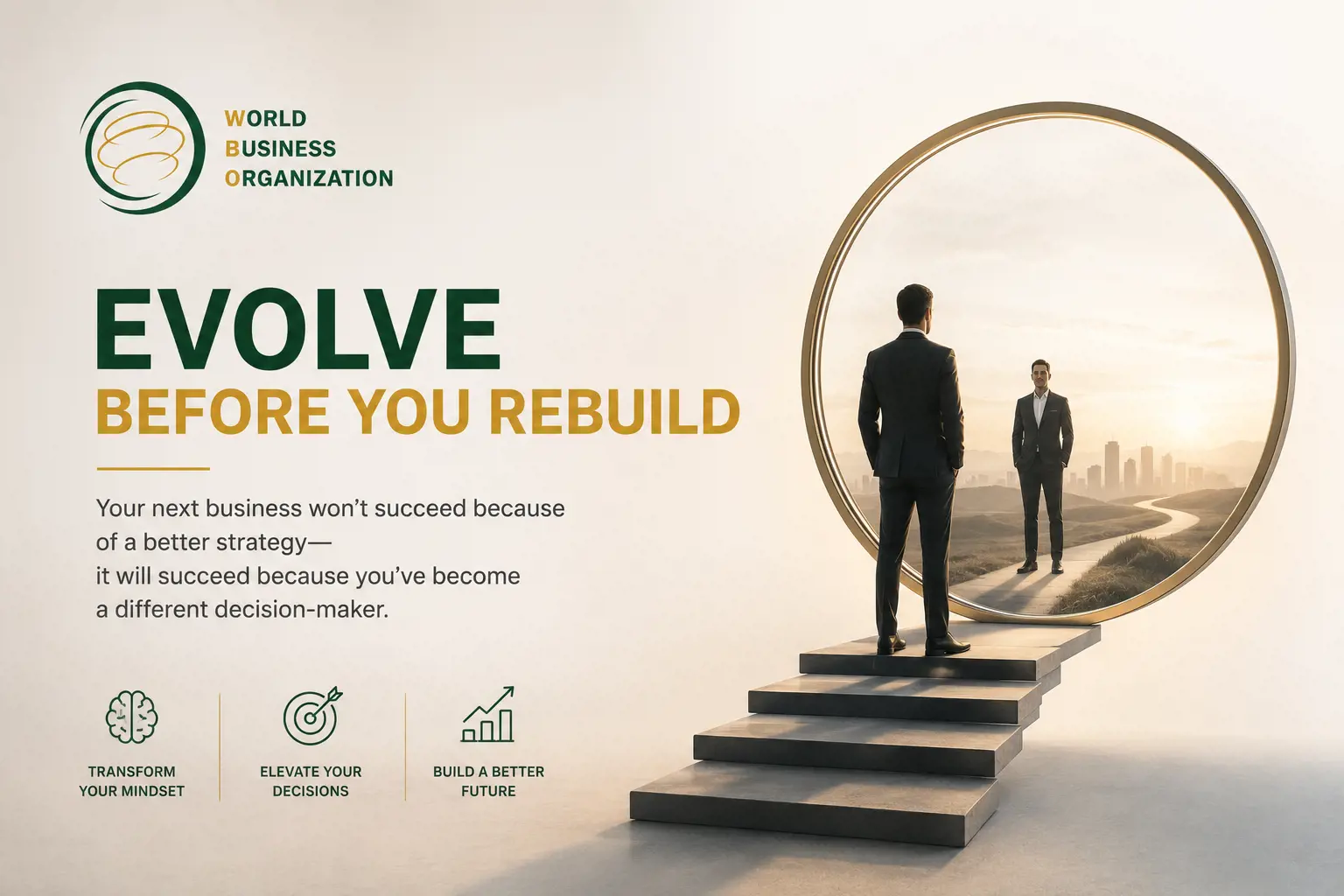
Your Next Business Doesn't Need a Better Strategy.
It Needs a Different Decision-Maker. Entrepreneurs often ask one question after a business failure:
"How do I rebuild my company?"**
It's an understandable question. But it may be the wrong one.
From a **PsychoTrade** perspective, the most valuable asset lost in a business failure isn't capital, customers, or market share. It's the founder's **Decision Identity**—the psychological framework through which every future business decision will be made. Most recovery advice focuses on rebuilding what was lost.
- Raise more capital.
- Develop a better strategy.
- Hire a stronger team.
- Optimize execution.
These are all important. But they assume something that is rarely questioned:
That the same person who made yesterday's decisions is the right person to make tomorrow's.
What if that assumption is wrong?
Every business is a reflection of the mind leading it. When a company succeeds, we often credit strategy. When it fails, we blame the market. Yet both success and failure are filtered through the founder's decision-making system.
Major business setback changes that system. It changes how uncertainty is interpreted.
- How risk is evaluated.
- How confidence is rebuilt.
- How opportunities are recognized.
The entrepreneur who starts again is not making decisions with the same mindset they had before the failure. The question is whether that change happens consciously or unconsciously. This is where **PsychoTrade** offers a different perspective.
- Recovery is not enough.
- Recovery returns you to where you were.
Evolution prepares you for where you're going. The founders who build remarkable second or third businesses are not simply more resilient. They have developed a new Decision Identity. They no longer make choices through the psychology that created the previous outcome. They think differently because they have become different decision-makers.
Perhaps this is the next evolution of business psychology. Instead of asking entrepreneurs how to recover from failure, we should ask a more powerful question:
**Who must you become before you build your next company?**
Because your next business does not need a better version of your old strategy. It needs a better version of the person making every strategic decision. Businesses don't grow simply because founders recover.
They grow because founders evolve. And that evolution begins long before the next product is launched, the next investor is found, or the next company is built.
It begins with the psychology of the person sitting in the founder's chair.
Dr. Sara Me
Psycho-Trade Think Tank Chairman