




Central Asia Unlocks Global Opportunities
Central Asia is entering a new era of economic transformation, positioning itself as one of the fastest-emerging strategic regions in global commerce. Driven by structural economic reforms, expanding regional cooperation, major infrastructure investments, and its unique geographical location, the region is increasingly being recognized as a vital bridge connecting Europe, Asia, and the Middle East. Governments, investors, and international organizations are now looking toward Central Asia not merely as a transit corridor, but as a rapidly expanding market with substantial industrial, commercial, and investment potential.
Among the region's economies, Uzbekistan has become the primary engine of this transformation. Comprehensive market reforms, trade liberalization, investment-friendly policies, and large-scale modernization programs have significantly enhanced the country's attractiveness for international business. With the largest population in Central Asia, a young and increasingly skilled workforce, expanding industrial capacity, abundant natural resources, and ambitious digital transformation initiatives, Uzbekistan is steadily establishing itself as a regional manufacturing, logistics, and commercial hub. Strategic investments in transportation infrastructure, free economic zones, renewable energy, agriculture, mining, textiles, pharmaceuticals, and advanced manufacturing continue to strengthen the country's position within global value chains.
The region's strategic significance extends well beyond its domestic markets. Central Asia occupies one of the most critical positions along the evolving Eurasian trade architecture, offering alternative transport corridors that connect European markets with Asia and the Gulf region. Growing investments in rail connectivity, multimodal logistics, dry ports, customs modernization, and digital trade infrastructure are reshaping regional supply chains and creating faster, more resilient trade routes. These developments are particularly important as businesses worldwide seek to diversify production networks, reduce geopolitical risks, and strengthen supply-chain resilience.
Equally significant is the growing economic convergence between Europe, Central Asia, and the Gulf Cooperation Council (GCC) countries. European economies contribute advanced technologies, industrial expertise, financial services, and sustainable investment, while Gulf nations continue expanding international investment portfolios through sovereign wealth funds, infrastructure financing, food security initiatives, logistics, and energy diversification strategies. Central Asia, positioned at the intersection of these two dynamic regions, offers a natural platform where capital, technology, manufacturing, natural resources, and international trade can converge to create mutually beneficial partnerships.
As global economic priorities shift toward connectivity, resilient supply chains, sustainable development, and regional economic integration, Central Asia is increasingly emerging as one of the world's most promising frontiers for international business. With Uzbekistan leading a new wave of economic modernization and regional openness, the strengthening commercial ties between Europe, Central Asia, and the Persian Gulf region are expected to generate significant opportunities for investment, industrial cooperation, SME development, innovation partnerships, and long-term economic growth. For the international business community, the region is no longer viewed as an emerging opportunity—it is rapidly becoming one of the defining economic crossroads of the twenty-first century.
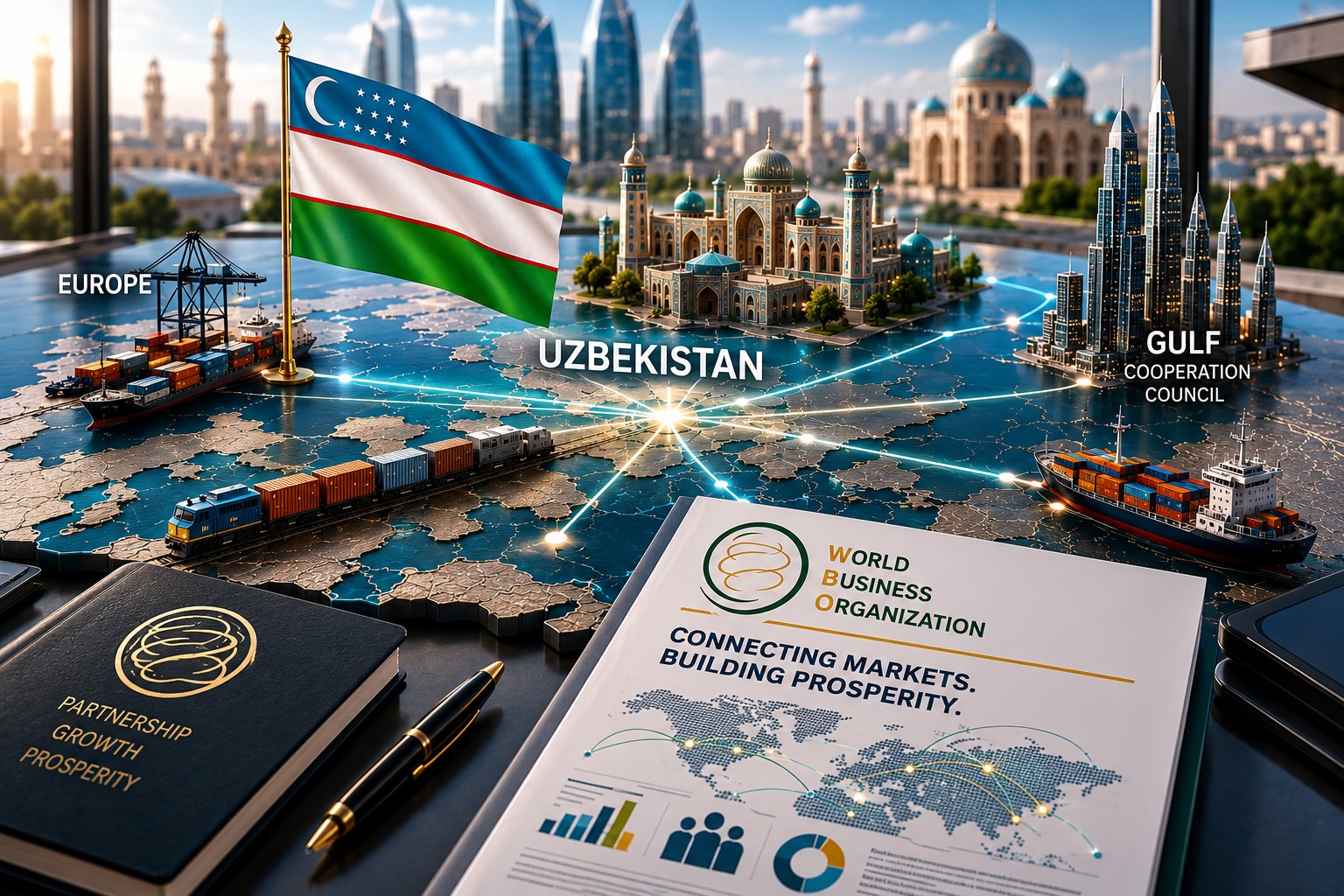
Central Asia is rapidly transforming into one of the world's most promising economic corridors. Led by Uzbekistan's ambitious reforms and supported by growing cooperation between Europe, the Persian Gulf region, and Eurasian markets, the region is attracting unprecedented attention as a strategic hub for trade, investment, logistics, manufacturing, and cross-border economic integration.
Font Size
1x
Reading time: 3 min