




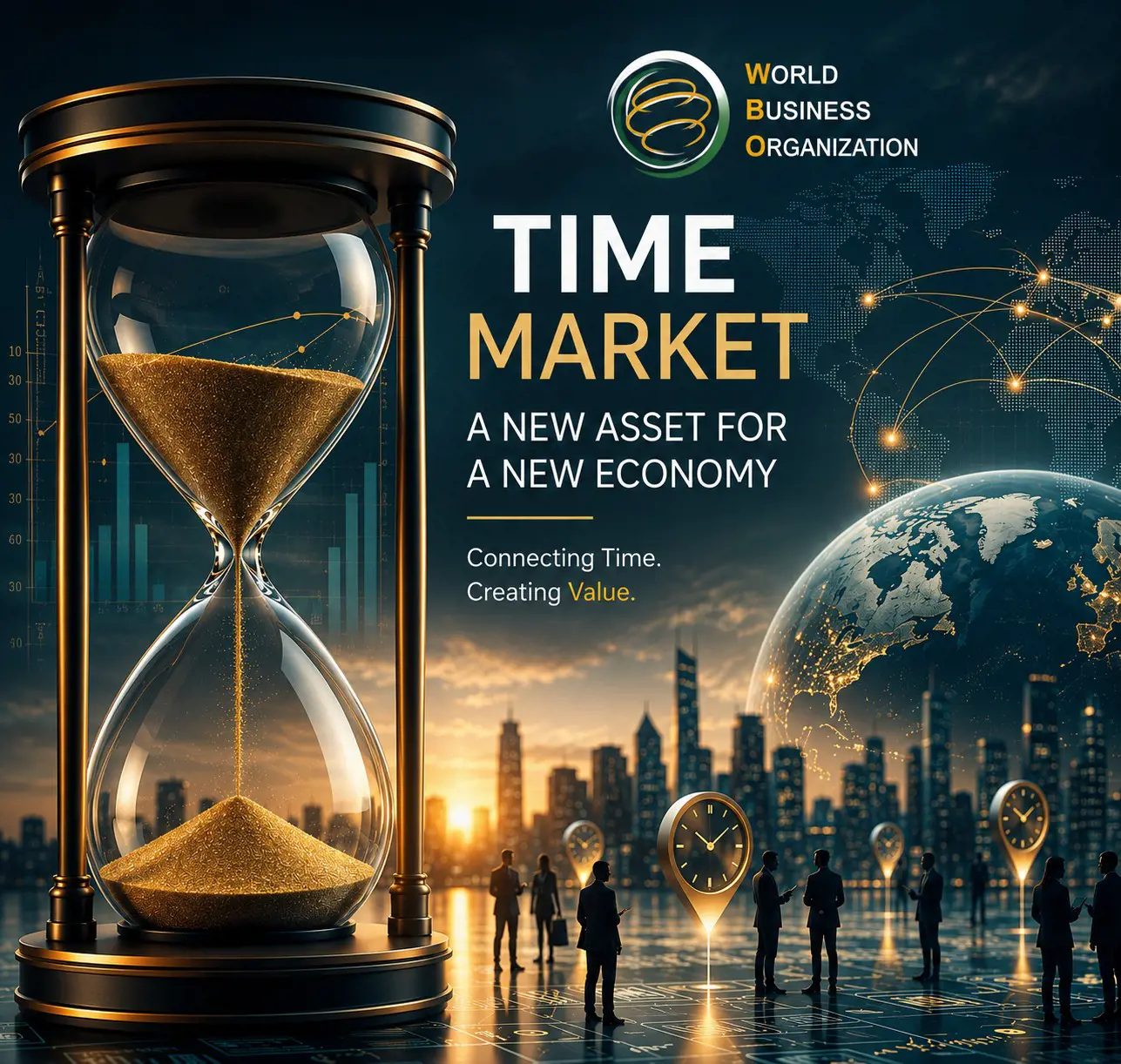
The World Business Organization (WBO) Unveils "Time Market":
A New Economic Paradigm Where Time Becomes a Tradable Global Asset
Geneva – For centuries, economies have revolved around the exchange of tangible goods, financial capital, natural resources, and intellectual property. While the digital revolution transformed information into one of the world's most valuable assets, one resource has remained largely invisible in economic systems despite being universally scarce and equally distributed among all people: time.
The World Business Organization (WBO) has announced the development of an ambitious global initiative known as the Time Market, a pioneering economic framework that seeks to recognize, standardize, and trade human time as a measurable economic asset.
Unlike conventional freelance platforms or labor marketplaces, the Time Market is not designed merely to connect buyers and sellers of services. Instead, it introduces an entirely new economic infrastructure where every individual's time is scientifically evaluated, digitally certified, and assigned an objective market value based on multiple measurable variables.
According to the architects of the project, the initiative represents one of the most significant conceptual shifts in modern economics.
"For centuries, people have traded products, services, money, and knowledge. The Time Market introduces a completely new asset class: verified human time."
The global economy may be on the verge of witnessing the birth of an entirely new asset class. The World Business Organization (WBO) has unveiled the Time Market, an ambitious initiative designed to transform one of humanity's most universal yet undervalued resources, time, into a measurable and tradable economic asset.
Unlike conventional labor or freelance marketplaces, the Time Market does not simply facilitate the buying and selling of services. Instead, it introduces a standardized economic framework that assigns an objective market value to every hour of professional time using a scientific pricing methodology.
At the heart of the initiative is a multidimensional valuation engine that calculates the economic value of an individual's time based on a combination of measurable factors, including geographic location, professional expertise, market demand, time scarcity, industry sector, customer type, behavioral performance, and personality characteristics. According to WBO, this approach aims to replace arbitrary hourly pricing with a transparent, data-driven valuation model capable of adapting to real market conditions.
The platform also introduces the concept of a Time Identity—a dynamic professional profile that evolves continuously as users gain experience, improve their reputation, complete successful projects, and strengthen their market position. Rather than relying solely on résumés or self-declared skills, the system evaluates both professional qualifications and verified performance indicators to determine an individual's economic value.
Artificial intelligence plays a central role in the ecosystem by continuously analyzing supply and demand, market trends, regional economic conditions, and professional performance. As these variables change, the market value of an individual's time is recalculated, creating a living marketplace where pricing reflects real economic dynamics instead of static hourly rates.
WBO believes the Time Market has the potential to reshape the way professionals, businesses, consultants, educators, researchers, and entrepreneurs exchange value across borders. By establishing a common international framework for valuing human time, the organization aims to reduce pricing uncertainty, improve transparency, and unlock new economic opportunities for millions of professionals worldwide.
If successfully implemented, the Time Market could represent one of the most significant innovations in modern economics—marking the transition from an economy centered on labor and services to one in which time itself becomes a globally recognized economic asset.