




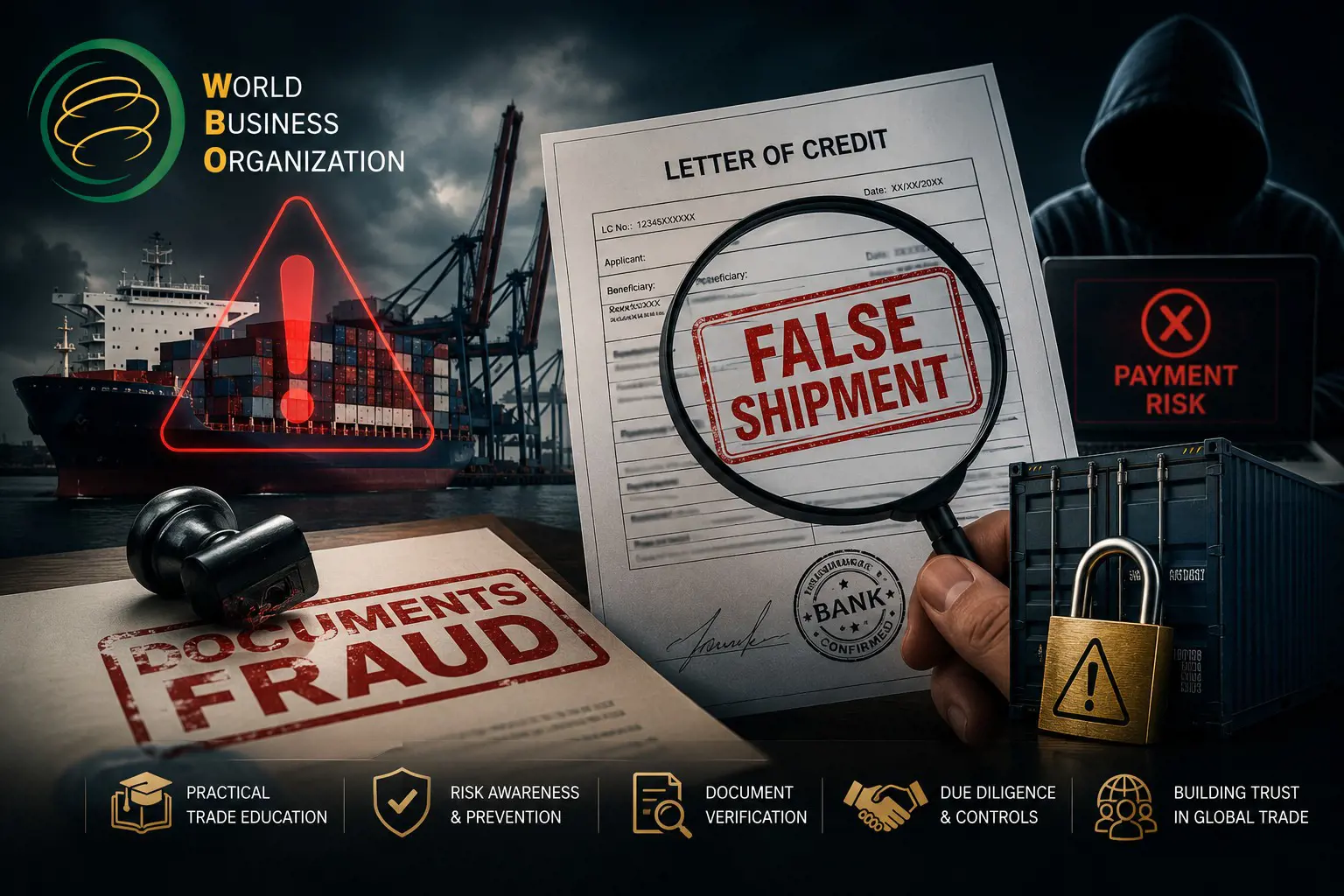
Threats Lurking: When LC Documents Hide a Fake Shipment
A Letter of Credit can provide an important level of payment security in international trade, but it does not eliminate fraud risk. One of the more sophisticated schemes involves fraudulent or manipulated trade documents presented under an apparently valid LC.
In a typical scenario, a seller presents documents that appear to comply with the LC—such as a commercial invoice, packing list, certificate of origin, insurance document, and transport document. However, the underlying goods may not exist, may never have been shipped, or may materially differ from what was agreed in the commercial contract. In some cases, documents are altered or obtained through fraudulent means to create the appearance of a genuine shipment.
The key lesson for traders is that documentary compliance and physical verification are not the same thing. A bank primarily examines documents against the terms and conditions of the credit; it does not generally perform a physical inspection of the goods simply because an LC has been issued.
Practical Controls for Traders
-
Verify the counterparty before issuing or accepting an LC. Do not allow the LC structure to replace proper KYC and commercial due diligence.
-
Examine the entire documentary chain. Invoice, packing list, transport document, certificate of origin, insurance and inspection documents should be logically consistent.
-
Use independent inspection for high-value or high-risk shipments. Where appropriate, require inspection by a reputable and independently selected inspection company.
-
Verify transport information. Where relevant, independently confirm shipment, vessel, container, carrier and routing information.
-
Compare documents with the underlying contract. Price, quantity, specifications, Incoterms®, delivery terms and shipment dates should make commercial sense.
-
Investigate unusual documentary patterns. Repeated amendments, inconsistent signatures, unusual issuing entities, last-minute document changes or unexplained intermediaries should trigger enhanced review.
-
Do not confuse a compliant presentation with proof that the goods are genuine.
WBO’s Practical Education Approach
The World Business Organization (WBO) considers trade-risk education an important component of responsible international business development. Through its educational and knowledge-sharing activities, WBO can help traders move beyond theoretical awareness and develop practical transaction-control skills—including how to read an LC, identify documentary inconsistencies, assess counterparty risk, understand the responsibilities of banks and commercial parties, and determine when independent verification is necessary.
The WBO practical education approach is based on a simple principle: traders should learn to identify the warning signs before committing capital, shipping goods, or accepting documentary risk. Case-based learning, transaction scenarios, document-review exercises, and practical checklists can help businesses transform knowledge into repeatable internal controls.
The Golden Rule
An LC can provide payment security—but it cannot replace due diligence on the transaction itself.
Before relying on an LC, ask:
Are the documents consistent? Is the shipment independently verifiable? Is the counterparty credible? And does the entire transaction make commercial sense?
In international trade, the strongest protection is not simply having an LC—it is knowing how to manage the risks surrounding it.
WBO Times | Threats Lurking
Know the risk. Verify the transaction. Protect the trade.
WBO Times | Threats Lurking
WBO Trade Risk & Compliance Desk
Practical Knowledge for Safer International Trade